Category: "Announcements"
Global firms hike spending on R&D
December 7th, 2017As China shifts its focus to attract more foreign investment in high-end manufacturing, services and green industry to transform its economy, overseas companies are pouring in additional funds to develop research and service-based businesses in China to maintain robust growth.
Many of these opportunities also come from the country's growing demand for consumption-related products and services, diversified market channels created by the Belt and Road Initiative and free trade deals with partner countries, as well as the hunger for more homemade sophisticated industrial products.
Thanks to the government's resolve to attract more foreign direct investment this year, segments newly identified as key to sustained growth?automation,
digitalization, financial and healthcare services, aviation, environmental technologies and renewable energy businesses?are all expected to benefit.
China's key areas for economic reform and industrial upgrading will grow into new opportunities in many German companies' investment plans, said Alexandra Voss, a member of the German Chamber of Commerce's all-China board.
"Consumption-related sectors will remain hot, and sectors that get well with China's new direction of economic growth, including high-tech, services and new energy, will also see more foreign investment," said Voss.
"Due to rising labor costs and weak global market demand, China is veering towards growth reliant on domestic consumption, rather than exports," said Gao Peiyong, director of the Institute of Economics at the Chinese Academy of Social Sciences.
Gao said companies from Europe, Japan and the United States have already discovered that it is time to invest more in Chinese research and development, as well as its science and technology and design businesses.
New growth points are expected to present themselves as the economy becomes more sophisticated.
Under government policies issued in January, foreign companies will be encouraged to invest in high-end, smart and green manufacturing; to set up research and development centers; and to strengthen cooperation with domestic peers. They will also be allowed to join national science and technology programs.
US-based Emerson Electric Co opened a new measurement technology center in Beijing on November 14 to serve its automation solutions business in China and across Asia. The facility, representing an investment of $28 million, includes the company's first China solutions center for customers and a newly built and expanded manufacturing plant to meet domestic and Asia-Pacific market demand.
David Farr, chairman and chief executive officer of Emerson, said with this new center, the company will be able to engage in closer collaboration with its customers in China in helping the industry adopt digital transformation technologies, as a growing number of Chinese companies are leveraging the growth potential arising from digitalization.
Siemens AG and Ningbo-based Consinee Group also kicked off their cooperation in a project for the first intelligent factory in China's wool textile industry on Nov 27. Involving a total investment of $50 million, Siemens will help its Chinese partner build 10 pilot intelligent production lines with an annual output of 1,000 metric tons of premium cashmere yarns.
Chinese firms need specialist expertise
December 5th, 2017Chinese companies will continue to see rising demand for bilingual talent, experts in Internet technology and human resources in 2018 amid globalization and China's Internet Plus strategy.
People who move to new jobs can expect an average salary increment of 10 to 20 percent while those who stay in their jobs can see a 5 to 8 percent rise in China in 2018, according to a report by Robert Walters, a global recruitment consultancy.
This year is likely to see a generally steady salary increase with an average 15 to 20 percent rise, but cooling from a rally last year.
With China being the biggest e-commerce market globally with rapid development in digital payments, automation, big data and artificial intelligence under the Internet Plus strategy, employees in information technology companies who change jobs may see a 12 to 18 percent jump in salary, according to the report yesterday.
The Belt and Road initiative and the Go Globally strategy are also driving Chinese companies to pursue bilingual professionals who have experience in international companies and understanding of local markets.
"The demand for bilingual talents is expected to rise sharply by over 50 percent in several years," said Sean Li, associate director of the Shanghai branch of Robert Walters.
Shanghai FTZ finalizes pilot program
December 31st, 2014'Parallel auto imports' will be allowed in new scheme
A pilot scheme for "parallel auto imports" in the China (Shanghai) Pilot Free Trade Zone (FTZ) has been finalized and will be rolled out soon, Xinhua reported Tuesday.
The move is expected to bring down vehicle prices and improve warranties and after-sales services.
"Parallel imports" refer to the practice of car dealers importing genuine vehicles from foreign markets to China without the permission of the manufacturer or the authorized distributor. Prices of cars imported this way are usually 15 percent to 20 percent lower than the cars imported via regular channels, as the import process is simplified, analysts said.
Details of the pilot scheme will be released soon, including the requirements for enterprises that could participate in the scheme and the institution of trade rules, Xinhua quoted Gu Jun, deputy head of Shanghai Municipal Commission of Commerce, as saying.
The State Council released a batch of measures to strengthen China's imports on November 6, including speeding up the rollout of the pilot program for "parallel car imports."
"Parallel imports" will drag auto prices to a reasonable level, Gu said.
After the State Council approved the scheme, related authorities have been working to figure out details, especially on the vehicles' quality safety and after-sales services, said Gu.
Lack of warranties and after-sales services is a major reason that consumers hesitate to buy the parallel imported vehicles. The pilot scheme aims to solve these problems.
Analysts suggest a services center be established in the Shanghai FTZ to provide registration, insurance, tax and maintenance services to cars that are imported through the pilot scheme. Furthermore, existing automobile dealership stores and auto repair shops could also be motivated to provide services to these vehicles.
Cars imported via such "parallel" channels amounted to 83,000 in 2013, accounting for 8 percent of the country's overall vehicle imports, according to data from China Automobile Dealers Association. Hu Siyu, an official with the association, expected that the number of parallel imported vehicles would rise by 32 percent year-on-year in 2014.
A total of 16 Land Rover and Mercedes-Benz cars were transported by rail to Southwest China's Chongqing on Thursday, marking the first time that China's western region has imported autos through "parallel" channels, Xinhua said Tuesday.
It took just 18 days for the vehicles to arrive in Chongqing from Germany's Duisburg. In comparison, it usually takes at least two months under regular channels, as imported vehicles are shipped to port cities such as Tianjin and Dalian first and then transported to the inland provinces, the report said.
Labor laws need to be overhauled
June 16th, 2014You see them everywhere in Asia.
They push street carts selling food and drinks, sell newspapers and water on busy intersections, and collect garbage for recycling while breathing in thick black smoke from the exhausts of trucks, buses and cars.
In the countryside they tend to small plots, growing just enough food to survive.
Despite Asia's massive economic gains over the last 30 years, very little of this new wealth has managed to trickle down to the grassroots, or what economists call the "informal economy".
The millions who work in the informal economy are not covered by formal employment agreements, which are so common in developed economies.
The International Labour Organization estimates the informal economy accounts for 60 percent of Asia's workforce.
The real challenge facing governments in emerging Asia is how to improve and protect those in the informal sector who have no protection from the non-payment of wages, and who can be retrenched at any time without notice or compensation.
They work in dangerous, low-skilled jobs with poor occupational health and safety conditions. None of them are protected by social security nets.
On the other hand, the formal sector - areas such as manufacturing, financial services and technology - is suffering from a growing skills shortage.
Asia reaped huge economic benefits when manufacturing migrated from many developed countries. Low-end manufacturing has even been migrating from China.
The World Bank has said the region's policymakers need to enact "labor regulations and social protection policies to benefit all workers, including those in the large informal economy".
Christophe Duchatellier, the Tokyo-based CEO of human resources firm Adecco Asia, says there has been a "significant deregulation of challenging labor laws" in many countries in Asia.
But he says that more deregulation still needs to be done if countries are to become "competitive from a labor perspective". Duchatellier says that over the last 20 years there has been a steady shift of industrial manufacturing from the West to the East.
Much of that shift was prompted by low productivity, high taxes and high wages in the West. "Companies need to do things cheaper and faster," he says, adding that the idea of a full-time job or 'job for life' is fast becoming a thing of the past in many global and regional markets."Young people want more options and will have more employers than we did in the past."
He believes Asian universities and schools need to better prepare young people entering the workforce with the right skills to help them get jobs.
"We need to remember that for the majority of the world, education is about preparing people to get a job. More 'later-in-life' retraining and re-skilling is needed for those in sunset industries and where new technologies are emerging. And companies need to encourage more apprenticeships," Duchatellier says.
A report released earlier this year by the World Bank, East Asia Pacific at Work: Employment, Enterprise and Well-Being, said: "Asia has seen rising productivity amid a brisk structural transformation, with large movement of people into cities and higher output in agriculture, manufacturing and services."
"Countries that were poor a generation ago successfully integrated into the global value chain, taking advantage of low labor costs," the report said.
Commenting on the report, Axel van Trotsenburg, regional vice-president of World Bank East Asia and Pacific, said: "The unprecedented economic development in East Asia Pacific has provided jobs and lifted millions of people out of poverty and has been a triumph of working people.
"It's time now to consolidate growth by adopting social policies that protect people, rather than any particular sector, location or profession."
When well-designed, those policies should make sure social protection and labor regulations benefit the most vulnerable workers in society."
The World Bank said that as economic growth is moderating and labor costs are rising, "constraints of the region's current labor market and social protection policies are becoming a more pressing issue".
Wal-Mart to shut down outlet in Hangzhou
April 11th, 2014
A customer shops at Wal-Mart's Zhaohui store in Hangzhou on Tuesday. Wal-Mart, the world's largest retailer by revenue, decided to shut down more than 20 outlets in China this year.
Closing part of company's plan to jettison underperforming stores
Wal-Mart Stores Inc, the world's largest retailer by revenue, plans to shut down another underperforming store?in Hangzhou, Zhejiang province?in late April, while a compensation dispute with employees from an inland store that closed in March remains unsolved.
Hu Yinghua, a saleswoman at Wal-Mart's Zhaohui store in Hangzhou, said they had a meeting on Wednesday afternoon as a formal notice of the closing of the store by the end of this month.
"The informal notification came on Tuesday night via text message. We have to choose before April 23 whether to be sent to other Wal-Mart stores in the city, or leave the company with a certain amount of compensation," she said.
Hu said upper-level managers explained during the meeting that the closure was strategically necessary.
There were a few customers at the store on Wednesday, but some shelves were already empty.
Shirley Zhang, media director from Wal-Mart China's Department of Corporate Affairs, confirmed that the store will close on April 23 as a part of the company's plan of shutting down those failing to make a profit.
The multinational company has opened about 400 stores on the Chinese mainland since it entered the market in the mid-1990s. The company decided to shut down more than 20 outlets in China this year because those stores comprise about 9 percent of the total, but have contributed only 2 to 3 percent of the total sales volume from 2013 to date, she said.
"We take these moves to achieve quality of growth, and we think the strategy adjustment will help us to better meet the demands of customers," she said.
Zhang said the company has tried to make proper arrangements for the employees affected by the closures, including allowing them to transfer to any outlet in China and subsidizing their relocation expenses, including transportation and accommodations.
However, the company's retreat from Changde was not seen as reasonable or fair by most of its local employees. More than 70 out of 135 employees from the store have asked their trade union to seek better compensation from the company after Wal-Mart told the workers on March 5 that the store would be closed in two weeks.
Huang Xingguo, chairman of the Changde store's trade union, said Wal-Mart did not provide an official notification to the trade union in advance for such a vital decision as the law stipulates and failed to show due respect to its employees.
"The day they announced the closure, employees from other cities arrived at the supermarket to replace our workers. It was humiliating and discriminatory," said Huang, whom employees elected as the trade union chairman in 2013.
He said the union has asked city authorities for formal arbitration to seek workers' rights in terms of collective negotiation, higher compensation for the mass layoffs, and pay for time not worked during the dispute.
"We ask Wal-Mart to double the existing compensation, but that is negotiable if the company is willing to resume dialogue," he said. "However, the company is busy removing its assets and has refused dialogue since late March."
Huang said Wal-Mart's tough stance was backed by inappropriate intervention from the local government.
He said the district's labor department provided written material to recognize that Wal-Mart closed its store in Changde legally, and police arrested several workers who took part in peaceful protests on March 21.
A labor inspection official surnamed Tan from Changde's Wuling district, who has been working as a mediator in the case, said the situation is "complicated" and urged workers to resort to legal channels to defend their rights.
Zhang, the media director from Wal-Mart China, defended the company's moves.
"Personally, I feel sympathetic toward these workers and understand their requirement for higher compensation, but our company has to handle that in accordance with the law," she said.
But Chang Kai, head of the School of Labor and Human Resources at Renmin University of China who participated in the legislation work for the Labor Contract Law from 2006 to 2008, believes Wal-Mart lacks legal justification for its behavior.
"The Changde outlet is just a branch of Wal-Mart, so it can't terminate employees' contracts under the name of disbanding the enterprise," he said. Under Chinese law, the company needs to provide an official resolution from a shareholders meeting to legitimize its decision to end its contracts with employees.
"What Wal-Mart did is actually a mass layoff, which requires the employer to inform workers one month in advance and listen to the trade union's suggestion for staff reallocation, which Wal-Mart has failed to do," he said.
Chang also said the trade union of Changde's Wal-Mart seeking better treatment for workers is significant, as it will set an example for similar cases in the future.
Guangdong outlines big FTZ plans
January 14th, 2014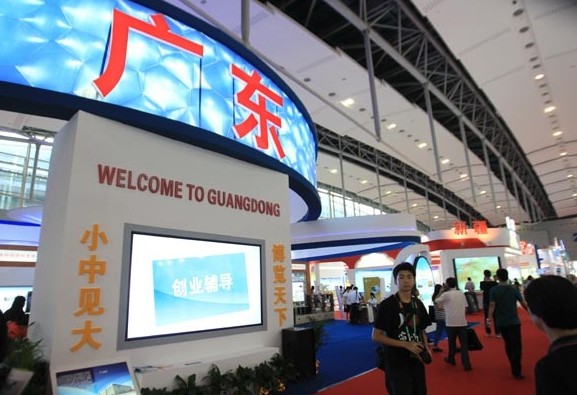
A booth showcasing Guangdong-based businesses at an expo in Guangzhou, the province's capital. Guangdong is currently seeking central government approval of a Guangdong-Hong Kong-Macao free trade zone. Provided to China Daily
Southern province aims to capitalize on links with neighboring regions
The Guangdong provincial government has vowed to realize liberalization of trade in services in the South China province and its neighboring Hong Kong and Macao special administrative regions by this year through CEPA (the Closer Economic Partnership Arrangement).
"It is a task assigned to Guangdong by the State Council," Vice-Governor Xu Shaohua told a Monday news conference. "We are striving for the central government's approval of specific preferential projects and policies.
"At the same time, we will open up more fields for investors from Hong Kong and Macao, including those in the service sector, using a 'negative list'."
Xu also said Guangdong is currently seeking central government approval of a Guangdong-Hong Kong-Macao free trade zone.
"We are talking with ministries about the construction plan and preferential policies," Xu said.
At a joint meeting between Guangdong and Hong Kong in September, Guangdong Governor Zhu Xiaodan said that the new free trade zone will focus on liberalizing trade and building a platform for the cooperation in the high-end service industry, capitalizing on Hong Kong's reputation as a premier international finance center.
A focus on liberalizing trade in services will set this free trade zone apart from the China (Shanghai) Pilot Free Trade Zone, which focuses on financial openness, according to Lin Jiang, dean of the public finance and taxation department of Lingnan College at the Guangzhou-based Sun Yat-sen University.
"The volume of trade in services has surpassed that of trade in goods in international trade," said Lin, who also is vice-director of the university's research center of Pearl River Delta, Hong Kong and Macao.
"The Guangdong-Hong Kong-Macao free trade zone is the pilot zone in China to make breakthroughs in fields such as offering tax refunds for service exports, which are intangible goods," Lin said.
"Liberalizing trade in services also answers the province's need for upgrading and transforming its processing trade. That's why the province doesn't stress liberalizing trade in goods," said Lin, who gave as examples of modern service industries high-end design and management consultancies.
Zhu also noted at the September meeting that the new free trade zone will help adapt the mainland's financial management mechanism to international practices in Hong Kong.
Lin said it will benefit the province to make business laws and regulations according to international practices in Hong Kong, since that will be one of the free trade zone's major incentives for international investors, compared with the Shanghai free trade zone.
Xu listed several items on the Guangdong government's action plan for liberalizing trade in services in the zone. They include: relaxing or canceling restrictions on Hong Kong and Macao investors' qualifications, shareholding ratios and/or scope of business; promoting mutual attestation of professional qualifications; and exploring possible business modes for individual professional services.
"The Hengqin New Area in Zhuhai, the Nansha New Area in Guangzhou and the Qianhai experimental zone in Shenzhen are the three areas opened up for Hong Kong service industry," Xu said. "In addition, Zhongshan, Foshan and Dongguan cities are proposing platforms to attract investors from Hong Kong and Macao."
The latest announced preliminary plan of the Guangdong-Hong Kong-Macao free trade zone includes the three new areas and experimental zones plus Guangzhou Baiyun International Airport, taking up an area of more than 1,300 square kilometers, which is 47 times of that of the Shanghai free trade zone.
Lin warned that it would be a challenge for the Guangdong government to figure out a way to coordinate so many areas.
Part of the reason for Monday's news conference was to interpret the provincial Party committee's suggestions for Guangdong's implementation of the central government's comprehensive reforms.
The suggestions were approved by the Third Plenum of the 11th General Assembly of the Guangdong Provincial Party Committee, held last weekend in Guangzhou.
"To further open up the province, Guangdong will also strengthen its cooperation with the US and European developed countries by establishing overseas offices of economic trade in these countries," Xu said, adding that an office in Germany already has been set up.
"This is to get in touch directly with big multinational corporations to attract investments and technologies that will assist in upgrading and transforming Guangdong's economy," he said.
Guangdong, the largest Chinese trader for ASEAN countries, also will further promote its foreign trade with these countries and spearhead the central government's strategy of building the Maritime Silk Road of the 21st century.
Shenzhen to Hike Minimum Wage Levels
December 31st, 2013Shenzhen human resource officials announced last week that the city will raise its monthly minimum wage level by 13 percent to RMB1,808 from February 1, 2014, while its hourly minimum wage will be adjusted from RMB14.5 to RMB16.5.
The new minimum wage standards are expected to benefit about 936,000 workers in Shenzhen, according to the city’s human resources and social security bureau.
In China, local governments are required to raise their minimum wage levels at least once every two years as a matter of State policy. Shenzhen last updated its minimum wage levels in March 2013, raising the monthly minimum pay by RMB100 to RMB1,600.
In 2013, twenty-seven regions in China have adjusted their minimum wage levels including: Shenzhen, Shanghai, Guangdong, Xinjiang, Tianjin, Jiangsu, Zhejiang, Beijing, Shandong, Fujian, Jilin, Liaoning, Hubei, Ningxia, Shanxi, Yunan, Anhui, Henan, Jiangxi, Guangxi, Gansu, Sichuan, Shaanxi and Guizhou. Detailed information can be found in the chart below.
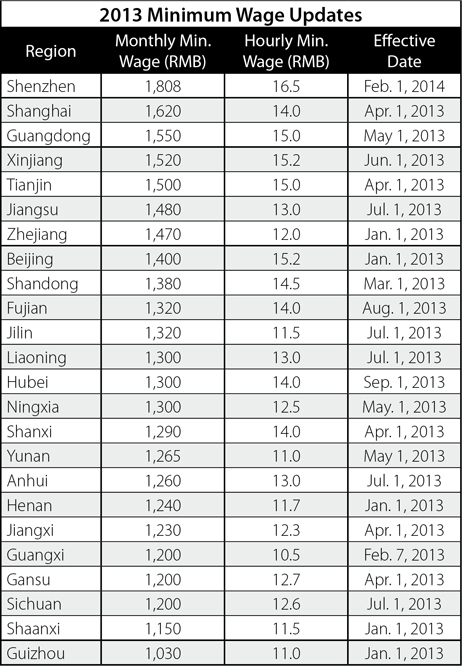
After the latest round of adjustments come into effect, Shenzhen will have the highest minimum wage in the country at RMB1,808, followed by Shanghai at RMB1,620. Shenzhen will also have the nation’s highest hourly wage rate at RMB16.5, followed by Beijing and Xinjiang at RMB 15.2.
The country’s Employment Promotion Plan provides that the minimum wage levels in China should grow by at least 13 percent annually through 2015, and the minimum wage levels in most areas should not be lower than 40 percent of the average local salary. Under such policies, minimum wage levels across the country have registered an average 12.6 percent annual growth rate from 2008-2012.
Dezan Shira & Associates is a specialist foreign direct investment practice, providing corporate establishment, business advisory, tax advisory and compliance, accounting, payroll, due diligence and financial review services to multinationals investing in emerging Asia. Since its establishment in 1992, the firm has grown into one of Asia’s most versatile full-service consultancies with operational offices across China, Hong Kong, India, Singapore and Vietnam as well as liaison offices in Italy and the United States.
For further details or to contact the firm, please email china@dezshira.com, visit www.dezshira.com, or download the company brochure.
You can stay up to date with the latest business and investment trends across Asia by subscribing to Asia Briefing’s complimentary update service featuring news, commentary, guides, and multimedia resources.
Retirement delayed as China confronts smaller workforce
December 26th, 2013China plans to raise the retirement age for the first time since the 1950s, as policymakers confront the prospect of a shrinking workforce that damps economic growth.
“The age will rise gradually,” Hu Xiaoyi, a vice minister of human resources and social security, said this month. China’s compulsory retirement ages, now 50 for most women and 60 for men, are likely in 2020 to be about five years higher than they are now, according to economists surveyed by Bloomberg News.
Delaying retirement may be a more effective tool in alleviating labour shortages and driving growth than the easing of the one-child policy announced last month as part of the broadest policy reforms since the 1990s. More than three decades of population control are thinning the ranks of available workers, adding to constraints on expansion as President Xi Jinping’s government seeks to rein in debt-fuelled investment.
“I would think that a lot of people would want to voluntarily work longer if the policies are right,” said Chang Jian, China economist at Barclays Plc in Hong Kong, who formerly worked at the World Bank. “The government would get a lot more mileage from raising the retirement age than a partial relaxation of the one-child policy,” she said.
“Twelve of 18 analysts saw 55 as closest to the 2020 retirement age for women, with five saying 60 and one 65,” according to the Bloomberg News survey, conducted from 22 November to 27 November.
Men’s retirement
The retirement age for men is likely to rise to about 65, according to 14 respondents, while two said it would be closer to 70 and two said it would stay near 60, the survey found.
For women in white-collar jobs, the retirement age is 55, and there are other exceptions such as for heavy labour.
The working-age labor force in China declined by 3.45 million people last year, according to the government. The United Nations has forecast a drop of about 24 million in the population age 15 to 59 from 2015 to 2025, while people age 65 and older will increase by about 66 million.
Scarcity is helping push up labour costs, driving companies such as Samsung Electronics Co. to relocate production to countries including Vietnam.
Raising the male retirement to 65 by 2020 may help keep in the labor force some of what statistics-bureau data show were 41.5 million men age 47 to 51 in 2011. There were 51.5 million women age 37 to 41.
Yu Yongding, a former adviser to the central bank, said a higher retirement age won’t change China’s demographic structure and trends. At the same time, it’s definitely helpful for China’s labour supply, and therefore good for economic growth in the long run, Yu, a senior researcher at the Chinese Academy of Social Sciences, said in an interview in Beijing.
Pension shortfall
Fourteen Chinese provinces faced a combined pension shortfall of 76.7 billion yuan ($12.6 billion) in 2011, according to a report by CASS, a state researcher, the official Xinhua News Agency reported in October.
“A delayed retirement age, despite its unpopularity, is helpful for China’s economic growth and development by allowing people to work longer and making more efficient use of labour,” said Li Xiaoping, a Beijing-based researcher with CASS’s Institute of Population and Labour Economics.
“Letting people have more children, while more popular, may carry fewer economic-growth benefits because boosting the population alone doesn’t necessarily help expansion,” Li said.
Wang Yuanlong, a 42-year-old taxicab driver in Beijing, said that if the retirement age is raised to 65, I don’t think it’s worthwhile to make my pension contributions.
“It’s bad to think that I have to work every day when I am 65,” Wang said.
Support growth
Avoiding deeper declines in the labour force may help support economic growth that analysts forecast will slow. Expansion will decelerate to 7.4% in 2014 and 7.2% in 2015, according to median estimates of economists in a separate Bloomberg News survey this month.
China is also trying to sustain growth by encouraging some of the 600 million-plus rural residents to relocate to cities and better integrating the 260 million migrant workers who live in urban areas without getting full access to schools and other municipal benefits.
The Communist Party said last month that couples will be allowed to have a second child if either parent is an only child, instead of both parents. The party said it would consider raising the retirement age.
“Delaying retirement will slow the process of China’s labour surplus becoming a deficit,” said Zhu Haibin, Hong Kong-based chief China economist at JPMorgan Chase and Co. The shift will have a much bigger impact on the economy than the change in the one-child policy, because that will only start to affect the labour force in 20 years’ time, Zhu said.
Life expectancy
China isn’t the only nation grappling with the issue. The UK plans to raise the pension age to 66 from 65 by 2020 and may raise it to 68 by the mid-2030s. Australia’s pension age is scheduled to rise to 67 from 65 by 2023, and the government may need to increase it later to 70, the nation’s Productivity Commission said in a research paper last month.
“National average life expectancy in China was 72 for men and 77 for women in 2010,” according to government data. The highest was 82 for women in Beijing and Shanghai.
“The age of 50 or 60 is no longer regarded as old,” Yang Yansui, director of Tsinghua University’s Research Center of Employment and Social Security, said in Beijing. “The pension system just can’t be sustained if the pension access age is not extended.”
Production to slow down: HSBC
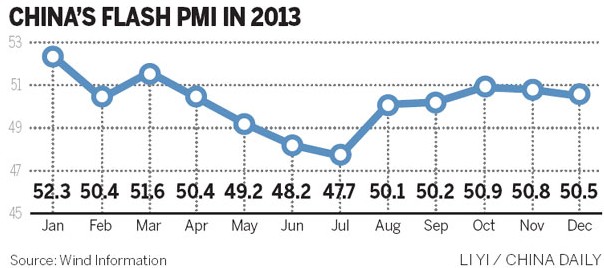
December 17th, 2013Workers assemble heavy equipment at a factory in Qingzhou, Shandong province. A preliminary reading of the Purchasing Managers' Index for the manufacturing industry edged down to 50.5 in December from 50.8 in November, the lowest level since October, HSBC Holdings Plc said in a report.
Preliminary manufacturing PMI shows weaker growth in December
China's manufacturing sector will likely see the slowest expansion in three months in December because of lower output growth, HSBC Holdings Plc said on Monday.
A preliminary reading of the Purchasing Managers' Index for the manufacturing industry edged down to 50.5 in December from 50.8 in November, the lowest level since October, the bank said in a report.
The production output sub-index slipped to 51.8 in December from 52.2 in November, pressuring the index.
Meanwhile, the new orders sub-index hit a nine-month high of 51.8 in December, compared with 51.7 in November, while the new export orders sub-index rose to 50.3 from 50.2 last month, suggesting stable market demand.
A reading above 50 indicates expansion, while one below that level signals contraction.
The official PMI data for December will be released on Jan 1 by the National Bureau of Statistics and the China Federation of Logistics and Purchasing. HSBC will release its final PMI data on Jan 2.
Qu Hongbin, chief economist in China at HSBC, said that although December's preliminary manufacturing PMI reading slowed marginally from November's final reading, it still stands above the third quarter's average reading of 49.7.
The latest reading implies that the manufacturing sector's recovery, which started in July, is still holding up, Qu said.
He believes that China's GDP growth will stabilize at about 7.8 percent year-on-year in the fourth quarter.
Zhang Zhiwei, chief economist in China at Nomura Securities Co Ltd, said that the slowdown in the PMI data "suggests that growth momentum has started to weaken".
"This trend is likely to continue in the first half of 2014, as market interest rates keep rising and pushing up financing costs for enterprises," said Zhang.
Figures from the central bank showed that new loans came in at 625 billion yuan ($103 billion) in November due to stronger retail and short-term corporate loans, rebounding from 506 billion yuan in October. Off-balance sheet lending saw a broad-based recovery to 377.9 billion yuan in November from 184 billion yuan in October but was still below the August-September levels.
A report from Barclays Capital said that short-term bill issuance has increased, as rising funding costs have probably led companies to rely more on short-term financing.
According to the NBS, industrial output growth in November slowed to 10 percent year-on-year from 10.3 percent in October, which may indicate that the GDP growth rate in the last quarter may be at 7.6 to 7.8 percent, compared with 7.8 percent in the third quarter and 7.5 percent in the second, analysts said.
Agency releases 2014 holiday plan
December 12th, 2013The national body responsible for deciding China's holiday dates has released the national holiday schedule for 2014, provoking mixed reactions from the public.

The schedule, issued by the General Office of the State Council on Wednesday, links official holiday periods with weekends, thus extending the number of consecutive days workers can take off.
The new arrangement means that Spring Festival and National Day holidays will be extended to seven-day breaks. Meanwhile, the Chinese Tomb Sweeping Day, Labor Day, Dragon Boat Festival and Mid-Autumn Festival will become three-day holidays. However, New Year will be celebrated as a one-day holiday.
Excluding the attached weekends, there will be 11 official days of holiday through 2014, a figure similar to previous years.
"I was hoping the total number of national holidays would increase. It is really disappointing that it didn' t go up at all," said Cheng Jia, 30, from Beijing.
Another Beijing resident, Wei Bo, 59, said: "I do not see much difference between the schedule for 2014 and previous years, except for the arrangement for Spring Festival holidays. According to the new schedule, we will still have to work on Chinese Lunar New Year' s Eve — the time we are supposed to have our family reunion. This is so inhumane."
Also on Wednesday, the State Council released amendments to the National Annual Leave and Memorial Days regulation dealing with national holidays. Enacted in 1949 and amended several times, it stipulates the specific days and lengths of national holidays.
This year' s amendment changed the Spring Festival to the first three days of the first lunar month of each year. According to a previous amendment to the regulation made in 2008, the three-day Spring Festival started on the last day of the lunar year.
Cai Jiming, director of the Center for Political Economy at Tsinghua University, who leads a team researching holiday system reform, was also involved in the 2008 amendment.
He said the change will bring inconvenience to people who are asked by employers to work till the last minute.
His team had proposed to expand the Spring Festival from three days to four days, but the proposal was not adopted by the government.
Taiwan asked to cooperate with free trade zone
October 30th, 2013The mainland and Taiwan adopted 19 joint proposals at the Ninth Cross-Straits Economic, Trade and Culture Forum, one of which encourages the island to cooperate with the new Shanghai Free Trade Zone.
The proposal, announced by John Chiang, vice-chairman of the Kuomintang, calls for cooperation between a pilot free economic area in Taiwan and the Shanghai Free Trade Zone as well as with three other pilot economic areas in eastern Fujian and Jiangsu provinces.
The free economic zones established by the two sides should cooperate and learn from each other to achieve common development, according to the proposal.
The Shanghai Free Trade Zone, which began operating in late September, is a 28.78-square-kilometer district billed as a test site for deepening market-oriented reforms.
Wu Poh-hsiung, KMT honorary chairman, said during his speech at the closing ceremony on Sunday he was delighted that both Taiwan and Shanghai have planned or established free trade zones and pilot free economic areas.
"We anticipate that the mainland and Taiwan will also consider cooperation opportunities in this field to give us more power to create a prosperous future," he said.
The forum, a key platform for communication between the mainland and Taiwan, ended on Sunday in Nanning, Guangxi Zhuang autonomous region.
With closer cross-Straits economic cooperation, the two sides should explore ways to keep pace with the Asia-Pacific region's economic integration, participants at the forum said.
The 19 proposals, which also cover cross-Straits cooperation in technology, finance, agriculture, education and tourism, are important and achievable, said Zhang Zhijun, the mainland's Taiwan affairs chief. The proposals reflect an urgency from both sides of the Taiwan Straits to stay competitive within international economic and scientific fields. The proposals will also provide a useful reference point for policymakers, said Zhang, head of the State Council Taiwan Affairs Office.
Zhang said both sides should seize opportunities to cooperate in order to increase advantages in global economic, scientific and technological competition.
"I truly hope relevant authorities from both sides turn these proposals into feasible policies and measures," Yu Zhengsheng, chairman of the National Committee of the Chinese People's Political Consultative Conference, said at Sunday's closing ceremony.
Yu urged both sides to overcome difficulties and seek opportunities to promote the peaceful development of cross-Straits ties and realize China's rejuvenation through cooperation.
Sun Zhaolin, deputy head of the Department of Taiwan, Hong Kong and Macao Affairs under the Ministry of Commerce, said it's advisable for the mainland and Taiwan to first reach a consensus on cooperation within the free trade zones before discussing details of cooperation.
In the proposals, participants urged both sides to expand financial cooperation by further opening their financial markets, jointly maintain stability in markets and build financial institutions on both sides to enhance exchanges. Participants also called on the two sides to promote cooperation in such sectors as culture, film, publishing, education, agriculture, medicine, as well as tourism and youth exchanges.
Shanghai elderly open to house-for-pension plan
September 25th, 2013More than 70 percent of elderly people in Shanghai are open to a house-for-pension program, a survey showed, despite a recent public outcry against the idea raised in a central government document.
According to the Shanghai investigation team under the National Bureau of Statistics, the program was supported by 73 percent of respondents as a possible means to ease the burden on elderly people in an aging society where people are choosing to have fewer or no children.
Under the program, an elderly person who owns a property could deed the house to an insurance company or bank, which would determine the value of the property and the applicant's life expectancy, and pay out a fixed amount of money every month.
The survey of 2,248 residents aged from 60 to 79 who have lived in Shanghai for more than one year found only 27 percent of respondents were firmly against the idea, the bureau's investigation team said in a report.
Those against the program cited various reasons including the possibility of family disputes, and that they don't need the program because their children will care for them in their old age.
Respondents in rural areas said the program is impossible because the land used for building rural houses cannot be traded.
Earlier this month, the State Council, China's cabinet, issued a document promising a complete social care network for people over the age of 60 by 2020.
The house-for-pension program, together with other policies such as encouraging private investment in elder care services, is dedicated to serving the world's largest population of elderly.
But the proposal drew wide criticism, with many suggesting that it shows the government is preparing to pay less attention to elder care services.
Experts said those respondents who said yes to the idea would not necessarily utilize the program.
"Intuitively, it is impossible to have such a high rate of people accepting the idea," said Feng Jin, a professor at Fudan University's Economics School.
"If you casually ask them, they may say yes to the program. But when they are requested to make the decision to mortgage their houses for a pension, it will be a different thing," she added.
In the United States, where a similar program has been in place for more than 20 years, only 2 percent of people aged 65 or above have mortgaged their houses for a pension, according to Feng.
In Hong Kong, only 11 percent of property owners accepted the idea, based on a survey in 2000 of 1,867 Hong Kong residents aged between 49 and 59.
A pilot program to test the idea by China Citic Bank in Shanghai proved unsuccessful because it did not comply with market demand, Feng added.
Yang Lei, founder of Huoban Jujia Homecare Service, said some elderly people showed interest in the program when she raised it.
All were childless or had children who had settled overseas, she said. "They accept the idea because they don't have a person to inherit their property," she added.
It is reasonable therefore that some oppose the idea in order to leave their house to their children, she said.
Wang Xiuzhen, 64, a retired worker, said a clear no to the proposal. "We are not Westerners. Asian culture promotes that you need to leave some heritage for your children."
The Shanghai survey also found 87.5 percent of respondents agreed with the concept of "raising sons to help in old age", and 67.3 percent supported the traditional concept of the family supporting its elderly members.
The respondents expected the authorities to provide more beds at care centers, improve community-based caring services and enhance the service level of those engaged in the sector, the survey found.
By the end of 2012, Shanghai had 3.67 million people aged 60 or older, accounting for 25.7 percent of its total registered population, according to Shanghai Civil Affairs Bureau. Shanghai also has millions of migrants who are not registered in the city.
Ministry of Human Resources and Social Security Seeks Comments on Regulating Labor Dispatch
August 16th, 2013China’s Ministry of Human Resources and Social Security issued provisions that align closely with recent changes to the PRC Labor Contract Law in order to help standardize labor dispatch in the country. The draft calls for a clearer definition of auxiliary positions, which will affect employers that historically employ a large amount of dispatched employees. However, a grace period is also provided so that employers can adjust their employment models in China.
On 7 August 2013, the Ministry of Human Resources and Social Security of the People’s Republic of China promulgated “Several Provisions on Labor Dispatch (Draft for Comments)” (the Draft) to solicit public opinion on how to regulate the labor dispatch in the country. This effort is intended to echo the Decision of Amendment of the Labor Contract Law (the Decision), effective from 1 July 2013, for the purpose of detailing the rules for labor dispatch and providing implementation guidance.
Highlights
Union Involvement
The Draft echoes the Decision’s recommendation that labor dispatch shall only apply to positions of temporary, auxiliary and substitutive nature (Three Characters). In addition to the established definitions that a temporary position applies only to a position lasting no longer than six months, and a substitutive position applies to a position vacated for off-work studies, time off, etc., the Draft specifies that an employer shall propose the list of auxiliary positions in line with industry features and business operation needs, and confirm the list upon consultation with a labor union or employee representative meeting before making it public.
The Draft further reinforces the supervisory function of the labor union in that if an employer violates the provisions—especially regarding Three Characters—or the maximum ratio of dispatched employees, the labor union is entitled to raise concerns and ask for corrective actions.
Maximum Ratio of Dispatched Employees
The Draft mandates 10 per cent as the maximum ratio for dispatched employees among the total employee pool of an employer. That said, an employer cannot unlimitedly set auxiliary positions and should be limited to the ratio ceiling at 10 per cent. Such limitation would have a great impact on companies that have a large amount of dispatched employees, and certain adjustments would be accommodated in order to comply with the law, as well as optimize the benefits for the business.
Expanded Coverage of Labor Dispatch Services
According to the Draft, if an employer subcontracts certain business operations to a third-party contractor but still takes direct control and management of the employees of the said contractor, such subcontracting behavior shall be regarded as labor dispatch, and therefore subject to the regulations on labor dispatch.
This expanded definition of labor dispatch is meant to prevent an employer from taking advantage of the subcontract to circumvent the restrictions and limitations for labor dispatch, including, but without limitation to, the maximum ratio of dispatched employees. Therefore, it requires special attention and due consideration when an employer intends to adopt the subcontracting model for certain parts of its business operations.
Liability
The penalty for violating the rules on labor dispatch is RMB 5,000 to RMB 10,000 per person. It is worth noting, however, that if an employer violates the relevant rules on labor dispatch, especially those of “Three Characters” and the ratio ceiling of auxiliary positions, and makes no rectification within one month of being given administrative penalty, the dispatched employees will be deemed to have established an employment relationship with the employer, and the employment contract will be deemed to take effect one day after the end of the one-month period after receiving the penalty.
Grace Period
The Draft provides a grace period for employers to be compliant. That said, any labor dispatch duly established prior to 1 July 2013, when the Decision took effect, shall continue to be in force until the expiration of the term period, which is up to two years. If the existing labor dispatch does not follow the "Equal Pay for Work of Equal Value" principle, it is further proposed that the amendment shall be made accordingly and immediately. Further, for any employer that has a large amount of dispatched employees exceeding the 10 per cent ratio ceiling, it shall not recruit any new dispatched employees, even for auxiliary positions.
Conclusion
To summarize, the Draft calls for clear identification of the auxiliary positions through participation in either a labor union or employee representative meeting followed by the strict 10 per cent ratio ceiling for all auxiliary positions in any event. This gives little room for an employer to maneuver if such employer historically has had a large amount of dispatched employees. However, the Draft also provides for a grace period so that an employer could take time to consider and adjust its employment model in China.
Plight of Chinese hawkers highlights impact of downturn
August 5th, 2013Every year the scorching Chinese summer brings throngs of unlicensed vendors out on to the streets, hawking everything from pirated DVDs to watermelons.
Given their lowly and illegal status they are often treated poorly by the authorities, but this year has been particularly bloody for this army of mobile shopkeepers.
Two weeks ago, Deng Zhengjia, a 56-year-old watermelon vendor, was killed and his wife knocked unconscious after they were attacked by the local “chengguan” – an auxiliary police force tasked with keeping city streets clean and orderly.
Since then there have been a dozen similar incidents reported across China in which “melon-peasants” (as they are referred to in Chinese), street hawkers, journalists and even police officers have been beaten up by locally-employed chengguan.
Chengguan brutality is not new, but experts say rising unemployment, particularly in the low-end export-orientated manufacturing sector, is driving up the number of vendors and prompting many more confrontations on the streets.
“The economic downturn has caused an increase in the unemployed and low-income populations and they have to return to the labour market which inevitably increases the conflict between chengguan and street vendors,” says Qiu Jianxin, an expert on the chengguan at Nanjing Aeronautics and Astronautics University.
Official Chinese unemployment data are virtually meaningless as they do not count the country’s hundreds of millions of migrant workers. According to a government manufacturing sector survey published on Thursday, however, employment in the sector has contracted for 13 months. A separate survey published by HSBC showed that the number of workers in the manufacturing sector shrank in July at its fastest pace since March 2009, with expectations of further job cuts.
The government has said 7.25m jobs were created in the first half of the year. But another survey from the Ministry of Human Resources and Social Security found that the number of new urban jobs fell by 5.7 per cent in the second quarter from the same period a year earlier.
“The employment situation is weakening in China,” says Zhu Haibin, chief China economist for JPMorgan. “The service sector is creating some jobs to hold up the overall labour market conditions but low-skilled manufacturing employment is particularly weak.”
A researcher at a government think-tank, who asked for anonymity, estimated that in some export-orientated manufacturing zones in south China one-third of migrant workers were still employed in factories, another third had switched to employment in the services sector while the final third had returned home to the countryside.
This balancing effect means China has not yet seen widespread net lay-offs despite three years of steadily slowing growth – from almost 12 per cent expansion in early 2010 to 7.5 per cent growth in the second quarter this year.
Without the pressure of massive unemployment the government has been unwilling to launch a major stimulus package to boost the economy as it did in late 2008 in the face of the global financial crisis. But the overall employment figures disguise the shifts that are occurring in the labour market and the potential dangers for China’s stability-obsessed government.
As news of Deng’s death in central China spread on social media, it caused outrage throughout the nation that was even expressed in official media outlets.
Local government officials in charge of the chengguan initially claimed he had “suddenly fallen to the ground and died”. But Beijing soon ordered the arrest of the officers involved and arranged for his family to receive a large payout.
“The government paid off the family quickly to shut them up because they are very worried this incident could spark wider protest or some sort of popular movement,” says Yang Jisheng, deputy editor at the reformist magazine Yanhuang Chunqiu.
Apart from there being fewer available jobs in the manufacturing sector there is also a mismatch between the jobs available and the skills and ambitions of those entering the workforce.
“There are studies that show a connection between unemployment and the number of street vendors in China,” says Ye Tan, a popular columnist who has written extensively about the chengguan. “But for many vendors the problem is not that they can’t find a job, but that they are unwilling to work long hours in high-risk manufacturing jobs.”
Because street vending is the main source of income for many of these migrants, the stakes are high when they are caught by chengguan, who regularly confiscate all of their wares and income. The chengguan often ask for protection money from vendors and regularly conduct street raids that can sometimes turn violent.
Just one day after Deng was killed, another melon vendor in northeast China was beaten up by chengguan in his city, in an incident that was captured on camera phones by witnesses. The footage was replayed by a regional state-controlled TV station whose journalists were themselves attacked by chengguan on camera when they went to the chengguan’s offices to check the facts of the case.
A week later, a police officer was reportedly beaten and had his pistol grabbed by a group of chengguan in western China after he was called to an incident in which the chengguan were attacking people.
Tech and execs see least talent movement in China
June 19th, 2013China’s technical workers in IT and engineering roles saw the lowest rate of people changing jobs in 2012 of any business function, at 18% and 24% respectively, followed by board-level staff at 27%.
The highest degree of movement was seen in government affairs (55%), construction (50%) and production (42%), according to Chinese recruitment firm RMG Selection.
A survey from the company of 2,000 Chinese workers shows that for 2013, 61% of IT workers have a greater desire to change jobs. Engineers (52%) were also seeing renewed keenness to move, as were production workers (57%) and supply chain professionals (52%).
The full Talent Flow Survey 2012-2013 is available via the RMG website. "http://www.rmgselection.com/downloads/RMG-China-Talent-flow-Survey-Report-2012-2013.pdf"
Hard times for grads
May 6th, 2013Only about 28 percent of graduates and 37 percent of postgraduates in Beijing had signed employment contracts as of late April, according to figures from the Beijing Municipal Commission of Education, the Beijing Times reported.
The changes in the international and domestic economic environment are the main reasons leading to the low employment rates of Chinese graduates this year, said an official from the commission. A total of 6.99 million college students will have graduated by June in China, the highest number since 1949.
Minimum wage hike helps workers as costs go up
April 8th, 2013Old Yang, a 55-year-old security guard in a residential complex, has been counting the days until his next paycheck. Effective this month, the minimum wage in Shanghai rises to 1,620 yuan (US$261) a month from 1,450 yuan.
Like most low-wage workers in the city, Old Yang is finding it hard to cope with rising prices for groceries, medicine, transport and the other basic necessities of life.
Sitting in the gate room of a residential compound on Anguo Road in Hongkou District, a cigarette glowing in his left hand, Old Yang said “food, transportation, tuition, water, gas and power bills. You have to pay for everything with the minimum wage.”
Old Yang lost his job during the global financial crisis in 2008 and found work as a security guard through a government-sponsored re-employment program aimed at helping jobless people in their 40s and 50s.
“Many jobless people chose to stay at home after the crisis,” Old Yang said. “I chose not to because my family needs money and I want to get a pension after retirement.”
His wife works part-time to help defray the cost of a son in college.
On March 29, the Shanghai government increased the minimum monthly wage by 11.7 percent, or 170 yuan. The minimum payment for part-time employment was lifted to 14 yuan from 12.5 yuan an hour, according to the government notice that took effect on April 1.
Nationally, Shanghai has the highest minimum wage of all 13 provinces and major cities in China. Its most recent rate of increase, however, isn’t as high as in some provinces, such as Jiangxi Province, which showed the biggest increase this year at 41.4 percent, according to People’s Daily.
The minimum wage in Shanghai has more than quadrupled, from 352 yuan, in the last 15 years. By 2020, China aims to double the per-capita income of both urban and rural residents from 2010 levels and narrow the gap between the rich and poor, according to a report from the 18th National Congress of the Communist Party of China that ended last November.
“The minimum wage will also be doubled by that time,” said Jennifer Feng, a senior human resource analyst with 51job.com, a Nasdaq-listed headhunting firm. “But you have to remember we are talking about net income. Actual take-home pay may be less, when social insurance fees and other mandatory costs are included.”
In its Five-Year Plan for the period ending 2015, the State Council, China’s Cabinet, stipulates annual increases of at least 13 percent.
“I think the latest increase is a balanced result, which takes into account the rising cost of living and the payroll tolerance capacity of employers,” Feng said. The risk, she said, is that employers, especially in manufacturing, may lay off staff or recruit lower-paid workers to replace experienced ones in order to lower their operating costs.
There were a dozen security guards in Old Yang’s residential compound last December. Now, there are only six.
“Maybe our boss knew he couldn’t afford so many of us, anticipating that the minimum wage would rise, so he fired them earlier,” Old Yang said.
He said his employer tends to hire local people like him because their social insurance fees are paid for by the government and the neighborhood committee under the re-employment plan.
Still, migrant workers are also commonly hired as security guards and cleaners in Shanghai. One such colleague of Old Yang’s, surnamed Zheng, lives in the basement of a high-rise in the housing complex, along with his wife, who works as a cleaner. Zheng, a native from central China’s Henan Province, declined to give his full name.
Zheng said the accommodation is free and he doesn’t have to pay utilities.
“Rent can gobble up nearly half of the minimum wage in Shanghai,” Zheng said. “The city is really too expensive to live in.”
For employers, the picture is mixed. A rise in minimum wages tends to make higher-paid workers think they should get raises, too. Feng said as wages rise, many employers are caught in a bind. Amid slower economic growth, they are under pressure to make more money, and wages account for a big chunk of operating cost. She suggests the government help share the burden by reducing business taxes or by defraying part of the cost of hiring people.
China issues new measures to boost employment
March 8th, 2013“China has slowed down its economic growth, but the employment goal has not been downgraded, which shows the Party and government’s determination to guarantee and improve people’s livelihood”, said Mo Rong, the director of Institute of International Labor and Social Security under Ministry of Human Resources and Social Security (MHRSS).
Mo said that thanks to the country’s positive employment policy, the employment target has been over fulfilled in the past few years. New records of employment rate were set Last year. But it does not mean that the employment plan in 2013 will be easily completed. Mo added that compared with the past five years, it is more difficult to achieve the employment goal in 2013 because the employment trend has changed this year.
Employment issue is the derivative demand of economy development. The increase rate of gross domestic product (GDP) decreased to 7.8 percent in 2012, and the increase rate of investment slumped last year.
Mo said the impact of investment decrease from last year will emerge this year. The government report in 2013 targets GDP increase rate of 7.5 percent extending last year’s situation, which will generate negative effects to increase new jobs by expanding scale of production. In addition to that, the complicated international economy situation and foreign trade pressure are adverse for the realization of the employment goal.
The government work report has presented some new methods to promote employment goals:
First, increase new jobs by stabilizing economy growth and adjusting economic structure. With a better performance of enterprises, stable economic growth and extended production scale, more jobs will be created. Meanwhile, structure adjustment will also increase working posts.
??
Second, improve employability and entrepreneurial capabilities and encourage people to start businesses to motivate employment.
Third, promote the steady growth of urban and rural residents’income to fuel economic growth by strengthening consumption ability.
China to reform income distribution mechanism
March 6th, 2013In a bid to address widening wealth gap, China has unveiled a major plan to reform its income distribution mechanism, proposing to tax the rich and state units more besides imposing caps on salaries of top managers while increasing lower staff pay.
The reform will focus on increasing residents' income, narrowing income distribution disparity and regulate distribution order, a statement issued by the China's Cabinet, which approved the 35-point blue print, said.
As per the reform plan, the government will work to double the average real income of urban and rural residents by 2020 from the 2010 level and facilitate the poor to enjoy faster income growth.
The reform also targets raising the proportion of residents' income in the overall national income and spending more government funds on social security and employment. However the statement said: “deepening the income distribution reform is a systematic project that is arduous and complicated and concerns the reallocation of various interests. There is no way to accomplish it overnight”.
The income reform plan was approved as China saw its income gap between new rich and poor was yawning, even with its economy emerging as second-largest in the world.
The Gini coefficient, a rich-poor index, reached 0.474 in China in 2012, higher than the warning level of 0.4 set by the United Nations. The reform plan was announced as wealth gap was identified as major threat to the ruling Communist Party of China's hold on power.
It came a month ahead of the one-in-a-decade power transfer under which new administration headed by CPC new leader Xi Jinping would take over power from next month replacing Hu Jintao.
The new guidelines offer directions on an extensive range of policy areas such as taxation, subsidies, salary system, financial regulation, household registration and social security.
The guidelines set a target of reducing the number of people living below the poverty line of 2,300 yuan ($366) in per capita annual net income at constant 2010 prices by around 80 million as of 2015. That will be a drastic fall from about 128 million in rural areas who were defined as poor in 2011. According to official estimates China has 150 million people under the poverty line.
Under the plan farmers will be guaranteed proceeds from transferring their contracted land plots and collect higher revenues from gains in the land value.
The plans aims at officials, state-owned enterprises (SOE) and wealthy individuals in its bid to strengthen regulation of the high-income group, state-run Xinhua news agency reported.
Rules that demand government officials report their income, real estate assets, investment and family members' jobs will be implemented more strictly, the guidelines said.
SOEs must impose ceilings on payments to their senior management who are appointed by the state and make sure senior staff's salary growth is slower than the average level for general employees, they said.
The percentage of profits that central SOEs have to hand in to the government will be increased by around 5 percentage points by 2015 from the current level and the added income will go to social security.
The guidelines also proposed keeping the staff scale of central and local governments from growing in the 2011-2015 period and rigorously controlling government spending on receptions, car purchases and driving as well as overseas tours.
To tax the rich more, the government will expand experimental property taxes gradually, collect consumption taxes on more high-end entertainment activities and luxury products, and study imposing inheritance taxes “at an appropriate time”.
In the meantime, foreign individuals will no longer be exempt from personal income taxes on stock dividends and bonuses they obtain from foreign-funded enterprises in China, according to the guidelines.
China Moves to Temper Growth
March 5th, 2013BEIJING—China set a growth target of around 7.5% for this year as it kicked off a meeting to finalize its leadership transition, reflecting how Beijing is turning away from breakneck growth based on exports in favor of a broader economy driven by spending at home.
China's ambitions for more moderate growth come after decades of double-digit increases and are a centerpiece of new leaders' plans to be detailed during the annual National People's Congress, which began Tuesday.
"We should unswervingly take expanding domestic demand as our long-term strategy for domestic development," said Premier Wen Jiabao, delivering his final report to the congress after 10 years at the helm. The key to that change, he said, is to "enhance people's ability to consume."
Beijing's broader goal is to shift the economy away from reliance on investment and exports, with a stronger role for domestic consumption, as it kick starts painful reforms to rebalance the country's economic model.
Underpinning that is an ambitious plan to raise household income and ensure more equal distribution of national wealth.
A stronger social safety net, which frees up money for households to spend, is an important part of the plan. The central government promised a substantial 27% increase in its health-care spending to $41.8 billion, and spending on employment and social welfare is also rising fast.
Mr. Wen also reiterated commitments to bring China's 200 million-plus migrant workers into the urban social welfare system and provide stronger protections for farmers' land rights, both seen as crucial to support higher household income and greater social equity.
On other economic matters, leaders reduced the inflation target to 3.5% from 4% in 2012, reflecting a goal of keeping expected price rises from accelerating too much. The fiscal deficit target was set at around 2% of GDP, up from 1.5% in 2012, as Beijing puts its relatively healthy balance sheet to work in support of growth.
In the days leading up to the legislative meeting, China's government aggressively struck at once-again-surging housing prices, showing leaders' determination not to let a property bubble push the economy off track or breed dissatisfaction with the government just as a new guard is taking over.
The growth target maintains the goal for stable growth set out last year and isn't a forecast—China routinely exceeds its targets. Last year's growth was 7.8%.
During the National People's Congress, eyes are on the new leadership under Xi Jinping, the Communist Party chief to be named president during the meeting, to see whether it will go beyond rhetoric to make the difficult changes required to raise household income and boost consumption spending.
Details on the timeline and implementation of reforms remain vague. And crucial questions remain unanswered on how cash-strapped local governments will pay for changes. Some analysts expect a major Communist Party meeting in October to fill in the blanks.
A bubbly property sector has been a key feature of China's unbalanced growth. Rising house prices drove overinvestment in real estate, and also crimped consumption by forcing households to scrimp and save to get their foot on the housing ladder. Leaders have worried about social frictions caused by housing that is out of reach for average earners.
The renewed controls to tame the property sector, a major contributor to growth, suggest the government is prepared to safeguard the gains from three years of attempts to make buying a home more affordable for the middle class—even if it dents the growth outlook.
The realization that leaders are retightening screws surprised markets, which like many property buyers had concluded that leaders were satisfied with the results of repeated tightening and willing to tolerate a gradual return to rising prices and sales.
Shares of Chinese developers plummeted on Monday, the first day of trading after policy makers said on Friday that they would strictly enforce a capital-gains tax of 20% on profits from home sales. China's State Council, or cabinet, also said it would reinforce controls on who is allowed to buy a home and push banks to raise down-payment and mortgage rates for second-home buyers in some cities.
The repeated tightening had resulted in prices leveling out. But in the past few months, house prices in China's top-tier cities have again started to rise at alarming rates. Average prices for property in Shanghai were up 41% from a year earlier in the first two months of the year, and Beijing prices are also rising fast, according to data from real-estate agency Soufun.
"The government has not been able to break the cycle of expectations pushing prices higher and driving higher expectations. Someone has to get hurt, to convince people China's property is not a surefire bet," said Mark Williams, China economist at Capital Economics.
Shenzhen-listed China Vanke Co., 000002.SZ +0.46% China's largest developer by volume was one of several property stocks to plunge the daily 10% trading limit Monday. The property hit helped drag China's benchmark Shanghai Composite Index down 3.7% for the day. Mainland developers in Hong Kong also fell sharply.
The market appeared to regain its footing in early trading Tuesday, with the Shanghai and Hong Kong markets opening fractionally up.
The recent uptick in property prices had raised questions about whether policy makers can deliver a more permanent solution to the problems of the housing market. Reaction to the latest moves in Shanghai was that they were likely to have a strong effect.
"Home prices will definitely take a hit once the new regulations are in place," said Chen Jun, a real-estate agent at Haiyu Dichan, a property agency in Shanghai.
Developers also took the move as a sign of the central government's determination to tighten the market. It "strengthens our view on the long-term nature of the property curbs," said a spokesman for China Vanke.
The measures to quell housing costs since April 2010 have left China's central government in a game of whack-a-mole with real-estate developers, local governments and speculators—all of whom have an interest in continued rapid increases in prices.
Leaders' efforts started to bring house prices back into line with income but did little to address the fundamental causes of China's property bubble, analysts say. Limited alternative investment options for households, local government reliance on land sales as a source of finance and the persistent belief that China's house prices can only go up meant the pressure for unsustainable rises in prices remains.
The latest moves appear aimed at preventing sharp increases in home prices spreading from China's first-tier cities to provincial capitals and smaller cities, where prices remain subdued. "The evidence is that prices in second-tier cities follow the top tier with a lag of a few months," said Jinsong Du, China real estate analyst at Credit Suisse. "The government wants to get ahead of that."
Property developers face the prospect of slower sales. Yuzhou Properties Co., 1628.HK -1.01% a developer in the southeastern city of Xiamen, said the new rules would delay the launch of their high-end homes. "We have to wait for an opportune time to launch the villas," said Leo Yang, investor-relations manager. "You can't possibly launch it when the country is going through a tightening phase."
The State Council has promised to expand China's nascent property tax, currently being tried in Shanghai and Chongqing. A nationwide tax would dent the enthusiasm of speculators by increasing the cost of holding property. But finding adequate new sources of revenue for local governments, and alternative investment options for households, remain intractable problems.
Many analysts expected rising property sales and investment—the biggest single source of China's domestic demand—to provide a tailwind to growth into 2013. But a weaker property market will hit demand for everything from steel to furniture to a car to park in the garage. Commodity exporters like Australia and Brazil, which feed China's steel mills, could also suffer.
Real-estate developers come into the downturn with their balance sheets relatively robust. "The listed developers had strong sales in 2012 and also raised debt in the bond market," said Mr. Du, the Credit Suisse analyst. "They are saying that local governments will go bankrupt before they do."
Labour dispatch services in China will provide less flexibility from 1 July 2013
January 18th, 2013From 1 July 2013, the use of labour dispatch services will likely be a less attractive means of maintaining a more flexible workforce. Companies taking dispatched employees will need to comply with an “equal pay for equal work” principle, and the range of positions for which they can engage dispatched workers will be limited. The registered capital requirement for labour dispatch service providers will also be increased four-fold. Forward planning for both labour dispatch services providers and companies that use dispatched employees is recommended.
Changes to China’s labour dispatch rules were enacted on 28 December 2012 by way of amendments to China’s Labour Contract Law. The amendments will be effective from 1 July 2013. For comment on the draft amendments that were circulated for public comment in mid-2012, please see our July 2012 e-bulletin.
Background
Labour dispatch practices involve a business choosing to outsource workers from third-party dispatch agencies rather than directly employing the workers. This can result in cost-savings and make it easier to terminate the relationship with the worker.
New provisions
The Labour Contract Law amendments introduce a number of changes, some of which are consistent with those in the draft amendment circulated in mid-2012. The first four changes listed below were not in the mid-2012 draft, while the remainder of the changes noted below are substantially the same as those in the mid-2012 draft:
• The registered capital of a labour dispatch company must be at least RMB2,000,000. This represents a four-fold increase from the current requirement of RMB500,000. Companies currently providing such services will need to increase their registered capital in order to provide further labour dispatch services.
• A labour dispatch company must have permanent business premises and facilities that are suitable for the conduct of their business. While it is unclear exactly what this will mean in practice, any existing dispatch service provider would be wise to carefully review the new requirements before renewing their leases.
• Employment by labour dispatch is only a supplemental form of employment for Chinese enterprises, with directemployment by labour contract being the basic form of employment. Identifying labour dispatch as supplementary is aimed at preventing the overuse of labour dispatch.
• The number of dispatched employees engaged by an employer may not exceed a certain percentage of its total number of employees. The exact percentage, however, is yet to be stipulated by the labour administrative authority under the State Council.
• To engage in labour dispatch, a labour dispatch company must obtain a permit from the relevant labour bureau. Labour dispatch permits had been explicitly required prior to 2008. However, when the PRC Labour Contract Law came into effect in 2008 it did not include a permit requirement. Under the new rules, a labour dispatch company established before 1 July 2013 will clearly be required to obtain a labour dispatch permit by 1 July 2014 in order to take up new labour dispatch business. Such labour dispatch companies will need to ensure that their registered capital and business premises comply with the new requirements.
• Workers can be dispatched only for “temporary, auxiliary or substitute positions”. Temporary positions cannot be for longer than six months; auxiliary positions are those that support the main business line; and substitute positions are for covering employees on vacations or study leave. The current rules, by contrast, are generally taken to permit long-term dispatch relationships in a wide variety of positions. This amendment emphasizes the supplemental nature of labour dispatch and is aimed at preventing labour dispatch from being a substitute for direct employment.
• The amendments require equal pay for equal work; that is, the same remuneration standard should apply to both dispatched employees and directly hired employees. Any existing labour contracts and labour dispatch agreements that are inconsistent with the "equal pay for equal work" requirement will need to be amended.
• Employers and dispatch agencies violating the law may be fined between RMB5,000 and RMB10,000 per dispatched worker if they fail to correct the violations within the time period specified by the relevant labour bureau.
Under the new rules, employers that have been relying on dispatched workers might be required to directly employ more workers. This would increase payrolls, and make future down-sizing more difficult and more expensive.
DFA warns of tougher China law on illegal workers
January 17th, 2013China's new immigration law, which will take effect on July 1, 2013, will impose stiffer penalties on those found to have violated it, the Philippine Consulate General in Guangzhou warned on Thursday.
In a statement sent by the Department of Foreign Affairs, the Consulate said the new immigration law provides particular attention to the so-called "three illegals" - illegal entry, residence and employment. Each violation is penalized with different and more severe penalty.
"Foreigners found illegally working in China may be subjected to a fine raning from RMB (renmibi) 5,000 to RMB20,000. Possible detention of five to 15 days may also be imposed for serious violations. Income acquired from illegal employment will also be confiscated. Illegal residents will be fined from RMB500 per day up to a maximum amount of RMB10,000, or imprisonment of five to 15 days," the statement said.
Under the new law, employers who hire foreigners without the proper permits and documentations will also be penalized.
The new law also provides fine and penalty of imprisonment to persons or organizations aiding foreigners in committing any activities defined under the so-called "three illegals."
The Consulate urged Filipino nationals affected by the changes in the immigration law to contact the Consulate for advice. The public is also warned about agents misrepresenting themselves as processors of exit visas for overstaying foreigners.
Chinese agency workers will be entitled to equal employment rights from July
January 9th, 2013Changes to Chinese employment law will limit the use of agency workers by companies, as well as guaranteeing those workers the same rights as those hired directly.08 Jan 2013
An amendment to the Labor Contract Law (Chinese) will limit the use of 'labor contracting agents' by companies to "temporary, supplementary or back-up jobs". The change, which has been adopted by the National People's Congress Standing Committee, is due to take effect on 1 July 2013 according to national press agency Xinhua.
The Labor Contract Law is one of China's main sources of employment legislation. It came into force in 2008 and is administered by the Ministry of Human Resources and Social Security. Among other provisions, the law requires employers to pay employees' health insurance and social security contributions, and includes protection for employees on probation and working overtime.
According to Xinhua, the amendment was proposed in June to prevent employers hiring long-term workers through agencies. According to Ministry figures, China had 37 million agency workers in 2011.In practice, companies can pay these workers much less than those recruited directly as they are categorised as 'dispatched employees'.
The amendment reiterates a right for agency workers, or "dispatched workers", to receive "equal pay for the same work" carried out by a company's "formal employees". Employers must "adopt the same remuneration distribution measures of its formal employees at the same position for such dispatched worker".
Employers will also be required to hire the majority of their workforce directly, rather than via contractors, and to strictly control the number of 'leased workers' they hire. The amendment also clarifies those roles that can be filled by agency workers. 'Temporary' jobs are those lasting no longer than six months, while 'back-up' jobs are those that can be taken over while permanent workers are on maternity, study or holiday leave.
The amendment also creates new administrative rules for labor contracting agencies. The minimum amount of registered capital that an agency must hold has been increased to 2 million yuan, while agencies will also be required to obtain administrative approval before they can begin arranging employment contracts.
At a press conference to introduce the changes Kan He, vice chair of the committee's legislative affairs commission, told Reuters that the changes were intended to "prevent abuse".
"The regulations control the total numbers and the proportion of workers that can be contracted through agencies and companies cannot expand either number or proportion at whim," he said. "The majority of workers at a company should be under regular labor contracts."
China moves to improve workers’ employment rights
January 7th, 2013China amended its labor law Dec 28 to ensure that workers hired through contracting agents are offered the same conditions as full employees, a move meant to tighten a loophole used by many employers to maintain flexible staffing.
Contracting agencies have taken off since China implemented the Labor Contract Law in 2008, which stipulates employers must pay workers’ health insurance and social security benefits and also makes firing them very difficult.
WORKFORCE
“Hiring via labor contracting agents should be arranged only for temporary, supplementary and backup jobs,” the amendment reads, according to Xinhua news agency. It takes effect on July 1.
Contracted laborers now make up about a third of the workforce at many Chinese and multinational factories and in some cases account for well over half
EMPLOYMENT AGENCIES
Some foreign representative offices, all news bureaus and most embassies are required to hire Chinese staff through employment agencies, rather than directly.
In theory contracted workers should be paid the same, with benefits supplied by the agencies who are legally their direct employers.
However, in reality many contracted workers, especially in manufacturing industries and state-owned enterprises, do not enjoy benefits and are paid less.
Employment agencies have been set up by local governments, and even by companies themselves, to keep an arms-length relationship with workers.
Workers who are underpaid, fired or suffer injury often find it very difficult to pursue compensation through the agencies.
SAMSUNG SUPPLIERS
Korean electronics giant Samsung Electronics said last month that it would require its 249 supplier factories in China to cap the number of temporary or contracted workers at 30 percent of regular full-time employees.
It announced the corrective measure after Chinese labor activists reported violations of overtime rules and working conditions as well as under-age workers at Samsung suppliers.
Samsung says its own audit did not find workers under China’s legal working age of 16 and therefore it had not violated any of China’s employment regulations..
China's wealth gap widening
December 28th, 2012Fresh data shows how China’s income gap is worsening, an issue new leader Xi Jinping has resolved to tackle.
While decades of strong economic growth have lifted hundreds of millions of Chinese off the poverty line, the country’s wealth gap has widened to the point where it is among the world’s most unequal nations.
China’s Gini coefficient, which is commonly used to gauge inequality in income or wealth, stood at 61 in 2010, according to a study by the Survey and Research Centre for China Household Finance.
The Gini coefficient measures the wealth gap on a scale of 0 to 100. A reading above 40 usually marks strong inequality in wealth and income.
The coefficient of all countries monitored by the World Bank averaged 44 for 2010. Ireland’s Gini coefficient in 2010 was 33.2, according to Eurostat, a sharply worse reading than in 2009, when it was 28.8.
The Gini data is extremely sensitive in China, and the government has not released an official figure since 2000, when it stood at 41.2.
‘ Rare ’
Gan Li, chief researcher and a professor at the research centre, which is part of the Southwestern University of Finance and Economics in Chengdu, said the reading was “rare in the world” and the gap was wide in both urban and rural areas.
But he said the reading was not “dreadful” because a wide gap between rich and poor was common in a fast-developing country.
One option would be to raise the minimum wage, but that would also hurt employment, he said. “We hope the government could spend more on improving people’s social welfare,” said Mr Gan.
Research earlier this year from the think tank showed that 10 per cent of Chinese households held up to 57 per cent of all disposable income.
The domestic east-west divide was stark, too. The combined income of all households in eastern provinces was about 2.7 times that of the west and central regions.
Central Economic Working Conference aims at guaranteeing people’s livelihood
December 27th, 2012The Central Economic Working Conference (CEWC) proposes the government enhance people’s livelihood and improve the standard of living. The goal is to be addressed under the guidelines of “keeping the bottom line, highlighting the key points, improving the mechanism and positively guiding the public opinion”.
The CEWC highlighted guaranteeing the basic life of low-income people. The government pledges to finance students born in poor families. Attention will be paid to stabilizing and expanding employment. The government will also strive to create more job opportunities for college students.
The government plans to shore up the development of small businesses and push large enterprises to recommit to corporate social responsibilities. The social insurance systems in both rural and urban areas will be enhanced. China will continue to intensify the construction and management of affordable housing and accelerate the transformation of shantytowns.
The Chinese government vows to lead people to setting in mind that to improve the living standard or become well-off is through hard work.
“To guarantee people’s livelihood requires the government to not only make every effort, but also have a clear evaluation of its own capability. To ‘keep the bottom line and highlight key points’ is very important,” commented Zhang Li Qun, researcher of macro-economic department in Development Research Center of the State Council.
Zhang said that one of the key points of the government’s work is to provide basic public services, and the bottom line is to guarantee the basic livelihood of people. The low-income group is problematic in society, and they especially need the help from the government. Furthermore, with the slowdown of economic growth and the promotion of economic restructuring, some people’s employment and income is expected to be affected. Therefore, the corresponding guarantees should be prepared earlier.
Zhang came up with one conclusion: that to improve people’s livelihood, on one hand the government should expand economic input, and on the other hand people should create wealth through hard work. Neither of the two should be neglected.
Measures boosting workforce expertise
December 14th, 2012A raft of favorable measures, including expanding recruitment programs, are leading to more foreign experts and expertise, a senior official said at a forum on Monday.
State-owned enterprises directly under the central government have hired more than 1,600 overseas employees, said Huang Shuhe, deputy director of the State Council's State-owned Assets Supervision and Administration Commission.
"International experts have helped these enterprises produce many of the world's leading technologies and products with their own intellectual property rights, and that has laid a foundation that will carry the enterprises forward," he said.
A number of recruitment programs are in operation.
The Recruitment Program of Global Experts is one and through it a research and development group, involved with 15 State-owned enterprises in Beijing, hired 136 high-level experts.
China started the program in 2008, in a bid to attract 2,000 overseas professionals to key projects across a range of sectors from engineering to finance.
Another recruitment program, which started last year, aims to introduce up to 1,000 foreign professionals over 10 years to help spur innovation, promote scientific research and corporate management.
The project has just brought in 94 recruits, according to Zhang Jianguo, director of the State Administration of Foreign Experts Affairs.
Professionals recruited by both programs will be entitled to subsidies, research allowances, favorable salaries, residency permits, medical care and insurance policies.
Professor Robert Gilbert, 66, was one of the new recruits.
Gilbert, an Australian who studies nutrition and food science, started work in China in October. He plans to build his own laboratory at Huazhong University of Science and Technology and Wuhan University.
China's emergence as a major global economy has made many foreign professionals shift their focus from traditional talent absorbers, such as the United States, he said.
"I enjoy being in China. It's very comfortable working and living here and I will probably prolong my stay in China when my contract ends in four years," he said.
Although China has been trying hard to attract international professionals, the country is still at the preliminary stage of attracting global talent, according to Wang Huiyao, director of the Center for China and Globalization in Beijing.
Only about 600,000 foreign professionals have work permits in China, while the US annually grants more than 100,000 green cards for foreign talent and nearly 90,000 talent visas, he said.
"We should do more to get global talent, for example by introducing more favorable and convenient visa and residence policies," he said.
Wu Jiang, director of the Chinese Academy of Personnel Science, said the country should optimize its structure of recruitment.
"For example, China only has 10 percent of its foreign experts working in the economic field. It's too low," he said. "We know what kind of talent we need most only after we get a better understanding of the country's talent and industrial structure."
The government should also provide better public services and make its legal environment for talent introduction better, Wu suggested.
China Bans Foreign Firms Hiring Labors in China to Work Abroad
August 28th, 2010By Bloomberg News
Aug. 23 (Bloomberg) -- China will crack down on foreign companies directly recruiting and hiring workers in China to do manual labor overseas, the Ministry of Commerce and the Ministry of Foreign Affairs said in a joint statement posted to the commerce ministry’s website today.
The government will also stop Chinese companies from sending labors from the nation to work overseas for foreign individuals, according to the statement. China will also strictly control the sending of Chinese labors to work in overseas nations where conditioners are worse than those domestically and where risks are high, according to the statement.
Join "China Job Openings, Career and Opportunities" Linkedin Group!
May 24th, 2010Join China Job Openings, Career and Opportunities: (just click to join – no cost).
Joining a group like this gives you access to other recruiter's China recruitment demand and helps you expand your network. They are an amazing and well-networked group of people which.
Internet Recruitment Slows In China, 51job.com Posts 5% Annual Revenue Decline
March 7th, 2010Showing that Chinese businesses were slow to hire new employees in 2009, Chinese online recruitment company 51job Inc. just revealed its unaudited financial results for the fourth quarter of 2009 and for the fiscal year ended December 31, 2009, and stated that revenues fell 5% from 2008.
While total revenues at 51job.com for the last quarter increased 15.2% over the fourth quarter of 2008 to CNY226.0 million, total revenues for the entire fiscal year 2009 decreased 5.0% from 2008 to CNY817.1 million.
Rick Yan, president and CEO of 51job Inc. stated: "In light of the challenges we faced and overcame in 2009, we were especially pleased to end the year on a high note by achieving record profit in the fourth quarter. We have observed a strengthening trend in market conditions and believe our online business in particular has carried solid momentum into 2010. In addition, with the opening of our new call center in Wuhan, this business is well positioned to not only extend our geographic reach and addressable employer base, but also streamline our service network for greater efficiency and margin expansion. We believe the year is off to a robust start for 51job."
Net income for the fourth quarter of 2009 increased to CNY46.4 million from CNY6.8 million for the same quarter in 2008. Fully diluted earnings per common share for the fourth quarter of 2009 were CNY0.84 compared with CNY0.12 for the same quarter in 2008. Fully diluted earnings per ADS for the fourth quarter of 2009 were CNY1.67 compared with CNY0.24 in the fourth quarter of 2008. Net income for 2009 increased 46.9% to CNY112.5 million from CNY76.6 million in 2008. Fully diluted earnings per common share for 2009 increased to CNY2.02 from CNY1.35 in 2008. Fully diluted earnings per ADS for 2009 were CNY4.03 compared with CNY2.70 in 2008.
Print advertising revenues for the fourth quarter of 2009 increased 8.2% to CNY64.6 million compared with CNY59.7 million for the same quarter in 2008. The increase was primarily due to higher average revenue per page, which was partially offset by a lower volume of print advertising pages in 51job Weekly resulting from a decline in market demand. Although print advertising prices in each city remained relatively unchanged, overall average revenue per page increased 39.8% over the fourth quarter of 2008 due to an increase in page volume contribution from cities where print advertising prices are generally higher as compared to the same quarter of the prior year. The estimated number of print advertising pages generated in the fourth quarter of 2009 decreased 22.6% to 2,672 compared with 3,452 pages in the same quarter in 2008.
The estimated number of print advertising pages generated in fiscal year 2009 decreased 29.4% to 11,661 compared with 16,512 estimated pages in 2008. Unique employers using the company's online recruitment services grew 39.9% to 143,451 in 2009 from 102,562 in 2008. Employers who purchase online services multiple times or in multiple quarters throughout the fiscal year are counted as one unique employer for the annual total.
Online recruitment services revenues for the fourth quarter of 2009 were CNY97.3 million, representing a 33.7% increase from CNY72.7 million for the same quarter of the prior year. Other human resource related revenues for the fourth quarter of 2009 increased 0.5% to CNY64.1 million from CNY63.8 million in the same quarter of 2008.
China Career Builder Corp. Announces Signed Letter of Intent to Acquire Issac Search Ltd
November 17th, 2009China Career Builder Corp., ("The Company or CCB") (PINK SHEETS: CCBX) a Delaware Corporation, is focused on outsourcing human resource services and staffing services in Hong Kong, China. Today, the company is pleased to announce has signed a Letter of Intent to acquires 49 percents of Issac Search Ltd of Hong Kong. This acquisition is consistent with the company's Strategic Business Plan, designed to build enterprise value through organic growth and select acquisition opportunities. The company is expected to complete satisfactory due diligence in the next Three (3) weeks, and complete the acquisition by the end of Q4, 2009 or early Q1 2010.
"We have been selectively considering strategic alliance or acquisition candidates for some time to achieve CCB's strategic vision. We are confident this acquisition with Issac Search Ltd enhances that vision and provides the elements required to expedite our business model," added CCB's President, Mona Yim.
ABOUT THE COMPANY
China Career Builder Corp. (The Company) through its subsidiary Asian Career Company Ltd. provides outsourcing human resource services and staffing services in Hong Kong, China. The company provides recruitment services focusing on the professional, management, clerical, administrative, IT and industrial market. Its services include screening, recruiting, training, workforce deployment, loss prevention and safety training, pre-employment testing and assessment, background searches, compensation program design, customized personnel management reports, job profiling, description, application, turnover tracking and analysis, opinion surveys and follow-up analysis, exit interviews and follow-up analysis, and management development skills workshops. The company markets its recruitment services through a combination of direct sales, telemarketing, trade shows, and advertising. The company incorporated in Delaware, headquartered in Hong Kong, China.
For further information please refer to the Company's website at www.ChinaCareerBuilder.com
If you would like to receive regular updates on China Career Builder Corp. please send your email request to info@ChinaCareerBuilder.com or contact the company's Investor and Public relations at ir@ChinaCareerBuilder.com .
Beijing seeks to attract talented overseas Chinese
June 15th, 2009Beijing is working to entice some of the talented Chinese people working overseas to return home.
The municipal government has established a program to assist overseas Chinese who are under 55 years of age, have obtained a PhD overseas, and can work in Beijing for more than six months a year.
Professors in famous overseas universities and research institutions and those who are employed as senior managers in well-known multi-national companies are the key targets of the program.
Beijing's goal for 2009 is to attract between 30 and 50 of these types of people back from overseas.
TSMC plans to hire up to 300 engineers
May 7th, 2009Taiwan Semiconductor Manufacturing Corp (TSMC, ???), the world’s biggest contract chipmaker, plans to hire up to 300 engineers after forecasting more than 80 percent growth in shipments this quarter, said recruiting agency 104 Corp (???), which is helping with the headhunt.
The recruitment drive is part of TSMC’s long-term investment in technological research and development, ensuring that it will be among the earliest companies to benefit once the economy recovers, 104 spokesman Max Fang (???) said.
“It is good timing for local employers to launch large-scale recruitment drives because the nation’s tough job market means a bigger selection,” Fang said. “We believe TSMC is just the beginning and there will be more recruitment programs by local companies later this year because hiring is usually closely linked to an economy improving, as it is now.”
An average of 10 candidates apply for each job offered by high-tech firms today, Fang said, as electronics firms hit by the recession remain cautious about hiring.
The Hsinchu-based chipmaker intends to hire between 200 and 300 design, processing technology and research engineers initially, potentially adding more positions later, Fang said.
As of the end of February, TSMC had about 22,000 employees globally, down 3.8 percent from about 22,800 at the end of last year, the company’s annual report said.
Meanwhile, competitor United Microelectronics Corp (UMC, ??) said it had no plans for significant additions to its payroll because prospects for the second half of the year were still unclear.
However, a UMC official said that the company expected strong growth in shipments in the second quarter.
UMC launched a major restructuring in the second half of last year, tweaking its organizational structure and streamlining its workforce to cut costs and improve profitability.
Separately, a survey conducted by 104 suggested an improvement in the domestic job market.
Job openings have increased 13 percent to 203,000 — the highest figure since last October — since the beginning of the year, when 180,000 jobs were on offer.
However, the number of job openings is half the number of current job seekers, meaning that the unemployment rate may not see an improvement in the short term.
The jobless rate hit a new high of 5.81 percent in March, with 670,000 adults unemployed, government figures showed.
This story has been viewed 581 times.
L'Oreal still hiring fresh graduates amid tough times
April 23rd, 2009L'OREAL is still recruiting fresh graduates here amid the tough economic environment, as it opts to cut costs by improving efficiency instead of scrapping jobs.
'Clearly we have to look at cost cutting but we're not looking at cutting heads,' said L'Oreal's executive vice-president for human resources Geoff Skingsley.
'We are not stopping recruiting of graduates. We have a steady long-term approach to recruitment.'
L'Oreal has a long-standing relationship with the National University of Singapore, he said.
However, the international cosmetics group is scaling back on recruiting more experienced staff.
Other ways in which it is containing costs include cutting travel budgets.
Despite the downturn, Asia remains a bright spot for the group.
'It's a high-growth region,' said Mr Skingsley.
'It's clear from a population point of view, from retail sophistication, demographic trends - all of these things here work in the favour of the beauty industry.'
Markets such as China and Thailand deliver steady growth, while newer markets such as Vietnam offer lots of potential.
In FY 2008, L'Oreal's Asian sales jumped 16.3 per cent year on year to 1.84 billion euros (S$3.59 billion). It reported consolidated sales of 17.542 billion euros for the year.
Based on the group's strong brands and innovative efforts, Mr Skingsley is upbeat about L'Oreal's ability to weather the economic storm.
'Our industry is one that retains relevance even when times are tough,' he said. A portfolio of 26 brands means a weaker performance by some is offset by a stronger showing by others.
L'Oreal remains committed to nurturing local talent. 'We take pride in giving international opportunities to people so they can gain exposure in other markets and bring that exposure back to their own markets,' Mr Skingsley said.
For instance, L'Oreal Singapore's new managing director Chris Neo is a Singaporean who has been with the company for 14 years.
L'Oreal employs 63,000 people worldwide, including 350 in Singapore.
Survey: 23% of China firms to freeze executives' salaries
March 5th, 2009A report by the human resources consulting firm Mercer shows that 23 percent of companies surveyed in China said their senior executives' compensation in 2009 wouldn't increase as usual, showing the effects of the global financial slowdown.
The survey involved 59 companies in China, 76 percent of which were listed companies and 39 percent of which were multinationals. Mercer conducted similar surveys in other Asian countries, including India, South Korea, Japan and Singapore.
"In Asia, one third of companies surveyed said their senior executives' salaries wouldn't increase in 2009. The proportion in China is a little smaller than the average, reflecting China experiencing less impact of the financial crisis than other Asian countries," said Zheng Wei, managing director for Asia executive remuneration business with Mercer.
"Considering the deferred impact on China's market, we predicted that more companies in China will take similar measures to limit the senior executives' salaries in 2009," Zheng added.
McDonald's to open 175 outlets in China, hiring more than 10,000
February 16th, 2009BEIJING (Xinhua) -- McDonald's China announced on Wednesday an expansion plan to set up 175 new outlets and create more than 10,000 jobs this year on the Chinese Mainland despite global economic downturn.
The expansion was the largest of its kind ever made by McDonald's across the world.
"The move will bring more opportunities for cooperation to food-related industries in China," said McDonald's China CEO Jeffrey Schwartz.
The US-based food chain store group has 50 suppliers in China, with more than 95 percent of its food materials coming from local market.
On the same day, the group announced its decision to launch a 16.5 yuan (about $2.4) discount meal in its Chinese outlets.
"The price is even lower than that of a similar product in this market a decade ago," said Schwartz.
He added the company's management of material supply and its increasing presence in China helped cost control and made the big discount possible.
McDonald's has opened more than 1,050 outlets in China in the past two decades.
Workers abroad must be 'better protected'
January 19th, 2009The government should take steps to better protect Chinese workers abroad, especially because their number could increase to more than 1 million in the next few years, experts said yesterday.
The experts were responding to reports that 23 Chinese working on a construction site in Saudi Arabia had been deported for protesting against poor pay. They were among the 200 Chinese workers who went on strike to demand better pay.
Many Chinese working overseas have had to weather problems such as kidnappings, attacks, frauds and economic disputes.
About 794,000 Chinese workers were hired to work overseas at end of November 2008 -51,000 more than the previous year - according to Ministry of Commerce figures.
But Lu Jinyong, professor of overseas investment at the University of International Business and Economics, said the actual figure could be much higher.
"The official figure comprises workers who have registered with the government before going abroad. It doesn't include workers who have left without registration," he said.
So "it's quite likely that the actual figure has crossed 1 million". And that number will continue to rise sharply, thanks to globalization, he said.
Across the world, about 30 million workers earn their livelihood away from their countries or regions. Bangladesh contributes about 2 million and the Philippines more than 1 million to that number. "Compared with them, the number of Chinese workers has a huge potential to grow," Lu said. And so will be dangers facing them.
The government shouldn't try to deal with the problem by tightening measures to curb labor export. "Instead, it should try to analyze Chinese workers' experiences and take steps to better protect them," he said.
The government has promulgated a special law on labor export, and the ministries of foreign affairs and commerce deal jointly with overseas incidents.
"Chinese embassies have done a very good job," he said, but local authorities should inform workers about the laws of the land they are headed to and how to put across their demands in the best possible way.
Xiao Lian, senior world economy scholar with the Chinese Academy of Social Sciences, said he saw workers from home "trapped" by their Chinese agencies when he was in Africa recently to attend a meeting. Such agencies are actually "human traffickers".
"Some local governments have granted permission to unscrupulous agents to handle labor export. So it's hard to tell who should shoulder the responsibility in case a dispute arises."
"This is a problem that needs to be solved urgently. The Saudi Arabian case once again proves it," he said.
Xiao suggested Chinese working overseas seek the help of the law to settle any dispute.
Ping An Insurance Slammed by Fortis’ Crisis, Exec Salaries
October 24th, 2008As the global financial fiasco bubbles along, China’s Ping An, its second largest insurance company, has found itself in hot water indeed.
Six months ago Ping An invested big in Fortis, a Belgium-based banking and insurance provider. Fortis now looks to be doing a Bear Stearns and that investment may be gone. Earlier this year, Ping An’s attempted fundraising stock issue worth 160 billion yuan caused a crash on the A-share market. And lately news of the salaries of Ping An executives has investors and the public up in arms.?
On the evening of Sept. 26, China Ping An Insurance (Group) Company, Ltd. (Ping An), announced its investment losses for the drop in Fortis’ share price had reached 10.524 billion yuan.
Ping An announced that based on international capital markets and the stock price volatility of Fortis, it will decide soon whether to make provision for asset impairment in its third quarter financial report, at the same time it will reflect market value losses in its income statement.
The notice said that regardless of any provision for impairment, the company's capital and solvency remain adequate.
According to a conservative estimate, the provision might amount to as much as 5 billion yuan based on 30% ratio for provision. Ping An's net profit in the first half was 7.102 billion yuan.
At the same time, Ping An stated that neither it nor its subsidiaries have risk exposure to Lehman Brothers, American International Group (AIG), Merrill Lynch, Bear Stearns, Fannie Mae, Freddie Mac or Washington Mutual in the US.
Last November, Ping An invested 1.81 billion euros in the purchase of 4.18% of the shares of Fortis on the secondary market, making Ping An its largest single shareholder. Ping An has gradually increased share holdings to 4.99%, the upper limit agreed on by two sides. This is the Chinese insurance industry’s biggest overseas investment.
On March 19 this year, the two companies separately announced that they will establish a global asset management partnership. Ping An is slated spend 2.15 billion euros (about 24.02 billion yuan) to buy 50% of the shares of Fortis Investment Management, a Fortis subsidiary conducting global asset management business. The deal has not yet been granted regulatory approval, according to Bloomberg Press.
November last year saw Fortis shares selling for around 17 euros, while the latest closing price was 5.20 euros per share, a fall of 21% over the same day. The bank, which is highly important to the regional economy, is on the edge of collapse as seized-up credit markets have made it extremely difficult for it to finance its operations. The governments of Belgium, Luxembourg and the Netherlands are scrambling to shore it up.
On September 26, Fortis Group announced it will replace the current CEO Herman Verwilst with 52-year-old Filip Dierckx. Herman Verwilst took the position after the sudden departure of the former CEO.
Fortis’ second quarter financial statement showed that net profit during that period was 830 million euros, down 49% from 1.62 billion euros netted second quarter a year ago.
In July this year, as Fortis shares fell below 10 dollars, institutions begun selling Ping An shares.
In addition to its floundering investment in Fortis, Ping An caused a huge stir this year among the public and investors with its pay-outs. Pre-tax salaries in 2007 of three directors and senior executives topped 40 million yuan. The pre-tax salary of Ma Mingzhe, president and CEO, alone was 66.161 million yuan (almost $10 million), equivalent to 181,200 per day, the highest of any senior executive of an A-share listed company.
Particular resentment over Ma’s compensation may well be related to two things: first Ping An’s try at launching of a 160 billion yuan refinancing plan on January 21 this year was one of the triggers of the subsequent and continuous A-share slide; and second, Ping An's share price has fallen from last October’s high of 149.28 yuan to its current lowest price of 48.30 yuan, a fall of 67.64%, a source of great pain for Ping An A-share holders. Against this backdrop, Ma’s 66.16 million yuan a year is conspicuous, and investors and the public see cause to be indignant.
On the last trading day before National Day, Ping An closed at 33.27 yuan on the news of Fortis Group, and fell 8.25% at closing, only one step away from its IPO price.
Frame the Future You Want: 4 Things to Do Right Now
October 14th, 2008When the economic markets look grim, hiring is at a standstill, and budgets are frozen, perspective is what is important. As some have said, “When things are good, they are never as good as they seem. And when things are bad, they are never as bad as they seem.”
We should all use the pause in the hectic pace of the past few years to begin and frame the future we want when we emerge. And we will emerge. I am not sure when, of course, but within a few years we will be back at the global hiring process with renewed vigor and increased challenges.
The cry we all heard over the past five years has been that there was no time to plan, think, experiment, or implement new methods. Most of us used the methods we were comfortable with but just worked harder, longer, and faster than before. This is the opportunity to figure out how to do things differently.
Be Strategically Bold; Tactically Careful
The first step in dealing with the current situation is to sit down and plan out a 3-5 year strategic plan for the future of your recruiting function. Envision a new tomorrow where you can use the technology, processes, and learnings that have emerged over the past decade. Some of the technologies and tools include such things as social networks, blogs, wikis, and candidate relationship management tools.
The processes that have shown promise include less-restrictive internal mobility practices, real time candidate assessment, virtual job fairs and other virtual recruiting techniques, as well as more authentic candidate engagement using online communication tools.
This strategic planning process should be formal, should involve your team and other employees as well as outside people, if that is acceptable in your organization, and should be designed to force yourself and others to think outside the usual assumptions about talent and recruiting. If you have any budget, it would be wise to engage a facilitator who is experienced in this kind of activity. They can make the process robust and much more valuable.
By formulating strategies that use these tools and practices, you can emerge from our current morass with a roadmap for quickly trumping your competition.
At the same time, you need to act right now with fiscal caution and show your management that you are a responsible manager.
This means finding ways to conserve your budget by lessening the need for contingent labor, perhaps, or by reassessing your current practices and challenge why you do whatever you doing the way you do it. Try to find ways to be more efficient, without spending money. Cut back, but cut back where it will do you some good from a strategic perspective. For example, by reducing staff right now, you can position yourself to implement technology or bring in a person with a different skill set once things recover.
Your job is to balance today with several possible recruiting situations in the future.
Envision a New Workforce
The really best recruiting and talent leaders will sit down with management and have some open discussions about the desired workforce of the future.
Every recession is an opportunity to recalibrate, learn and decide on what skills and competencies are most likely to be needed as we emerge from this recession. I have lived through a few recessions now and one lesson I have learned is that out of each come new needs. As we emerged from the September 11 mini-recession, it was clear that security was the new issue and that we would need people with experience and skills not only in physical security but also in data and financial security. By anticipating these needs, recruiters could have had an edge on any competition.
Once you have even a blurry picture of the skills and competencies you may need, you can begin sourcing for these kinds of candidates and begin to populate a talent community with people whom you are getting to know and who are getting to know you.
Collaborate and Learn
Your third step is to collaborate and learn from your peers and from experts in the field. This is a golden opportunity to attend webinars, which are mostly free, catch up on the blogs you have wanted to read but didn’t have time to, and make a few phone calls to friends, colleagues, and others you may have heard of.
These calls can be partly social and partly learning experiences. Ask what they are experiencing, what they are doing to use this gift of time wisely, and what tools and practices they are considering. I have always found this kind of networking to be one of the best ways to learn about emerging trends and to get a calibration on where others are.
Everything you hear and learn can be used as part of your strategic planning process. You can get these colleagues to demonstrate what they have done and you can even experiment with many of the technologies for free or for a small amount of money. One of the best things about the past five years is how inexpensive software has become. There is really no excuse to not try blogging, wikis, or even social networking tools.
Focus on Candidate Engagement
The final step in your plan for the future is to carefully, authentically, and regularly communicate with all the best candidates you have. Experiment with tools like blogs, email, newsletters, Twitter updates – anything that might engage and stimulate the many potential candidates you should already have in your talent pools.
If you neglect them or just tell them that there are no openings now, you lose a resource that you have spent lots of time and money finding and developing. Better to be honest with them, let them know exactly what your situation is, and keep them updated regularly.
Invite the best to join you in a monthly phone call update (just like your financial people do for the analysts) or hold a quarterly webinar. Anything you do to maintain the connection with your candidates will pay itself back when times get better.
Economies will recover and the emerging world will be different and more challenging than ever. Use this precious resource of extra time wisely and well to frame the future you want.
Workers’ rights get new boost
October 9th, 2008Workers in Guangdong province, under a new regulation, will now have the right to claim compensation for work-related injures or sickness within two years of ceasing employment.
Zhang Xiang, a publicity official of the provincial labor and security department, said yesterday the introduction of the new regulation "is partly due an illness suffered by a woman worker in Shunde district, Foshan city".
The worker, Ye Biqiong, was employed by a packaging factory in Foshan in 1993.
Ye's employer purchased insurance against injury for her in 2000.
Ye quit her job in 2006 because of illness.
In 2007, Ye was diagnosed with serious benzene poisoning, which had been certified as being caused by her work at the factory.
Ye and her former employer tried to claim work injury compensation from the social insurance fund bureau of Shunde, but they were turned down.
??The reason being Ye had left the factory before she was diagnosed with the disease.
In May this year, Ye and her former employer brought the bureau to court.
The case drew wide media attention, and the provincial government began to realize that many other people in Guangdong province were in a similar position to Ye, Zhang said.
The director of the Guangdong prevention and treatment center for occupational diseases, Huang Hanlin, the attorney of Ye, Huang Shumei, and a law professor of Sun Yat-sen University, Huang Qiaoyan, also jointly sent a petition letter to the provincial government suggesting that it require the labor and social security department improve its injury compensation regulation.
Under the new regulation a worker who has been diagnosed as having contracted an occupational disease can claim insurance compensation from the labor and social security department even though no longer employed.
The only precondition is that the claim must be made within two years.
The provincial labor and social security department said it released an official announcement on Saturday, and the new regulation would take effect from that day.
"The Shunde branch of the Foshan social insurance fund bureau has accepted Ye's case and we have withdrawn our lawsuit," attorney Huang Shumei said.
Spike in US unemployment claims
September 26th, 2008THE number of Americans filing first-time claims for unemployment benefits rose last week to the highest level since September 2001, as hurricanes kept residents of Texas and Louisiana out of work.
Initial jobless claims increased by 32,000 to 493,000 in the week that ended last Saturday, from 461,000 in the prior week, Bloomberg News reported the United States government as saying yesterday.
Hurricanes Ike and Gustav added 50,000 claims, the department said.
The figures may reinforce concern that consumer spending, which accounts for more than two-thirds of the United States economy, will falter.
Growth is already slowing due to the housing slump and the worst financial crisis since the Great Depression.
"The labor market is clearly in recession," said Steven Wood, president of California-based Insight Economics LLC.
The number of people continuing to collect jobless benefits climbed close to a five-year high of 3.542 million in the week ending on September 13, from 3.479 million in the prior week.
Taiwan to mainland job boat is still afloat
September 8th, 2008Last year, Phoebe Sun began to feel that her native Taiwan was too small for her to develop her career as an advertising executive.
She had been working in Taipei since graduating from business school in 2001 and wanted to try somewhere new.
After going to mainland China for the first time last summer, the 30-year-old decided she wanted to work there.
So she applied for a job in Beijing, was hired and moved to the city last December, thus joining the growing number of Taiwanese who go to the mainland in search of better career prospects.
"The Chinese market is huge and full of opportunities. I was hoping to gain some experience that I would not be able to get in Taipei," says Ms Sun.
China has long been a popular place for Taiwanese to set up business because of its proximity and low cost-base. More than 1m Taiwanese now live in mainland China, according to estimates by Hung Hxi-yao, deputy secretary general of the Association of Taiwan Investment Enterprises on the Mainland (ATIEM).
A number of Taiwanese companies, in sectors such as manufacturing and semiconductors, also have transferred their operations from the island state to China, where they can save on costs and develop their businesses on a bigger scale.
Some companies in China, meanwhile, like to hire Taiwanese because they speak the same language and are culturally very similar.
"Taiwan was once ruled by the Japanese, who have very high loyalty to their companies and respect seniority. We have learnt these qualities from them and they are what many Chinese employers look for," says Alex Hsu, general manager of MGR Search & Selection (Pasona Group), a Taipei-based recruitment firm.
For multinational companies in China, which usually have top-level executives relocated from other countries and large numbers of mainland graduates for junior posts, Taiwanese employees can fill a wide gap at the middle management level.
Taiwan is the biggest source of foreign workers for Chinese employers, according to a 2008 survey by Manpower, the international employment services company.
"One of our surveys shows that the top three kinds of job in which foreign talent is most needed in China are senior executives, middle management and engineers. Taiwan has them all. It's simply a question of supply and demand," says Lucille Wu, managing director of Manpower Greater China.
Against a backdrop of warming relations between Beijing and Taipei, ATIEM's Mr Hung expects the mainland's population of Taiwanese expatriates to reach 1.5m by the end of the year.
Since Ma Ying-jeou became Taiwan's president in May, his administration has overseen the resumption of direct air links with China, partly removed restrictions on Taiwanese companies' investments in China, and liberalised cross-Strait investments.
"Taiwan and China are becoming closer and closer since Mr Ma took over. A lot of Taiwanese feel they are Chinese too," says Beijing-based Mr Hung. "With China being such an important economy, it's only natural for them to want to work here."
According to a recent survey by 104 Job Bank, a Taiwanese headhunting agency, 45 per cent of jobseekers in Taiwan are interested in working in China. Nearly 70 per cent people say they are attracted by the potential of China's economy, which expanded 10.4 per cent in the first half of 2008.
Economic growth in Taiwan, meanwhile, is less than 5 per cent, which contributes to a subdued job market in the island state.
Although higher salary is not one of the factors cited in the survey, some people, especially those who work for multinational companies, do get paid more in China. MGR's Mr Hsu says a human resources manager who works for a US company in China could be paid one-third more than their counterpart in Taipei.
"Increasingly, many Taiwanese are being considered local hires in China. Many don't get expat packages any more" says Mr Hsu.
To make themselves even more attractive to Chinese companies, Taiwanese employees sometimes ask for lower salaries than other workers from the region, who often pay lower employment taxes at home. Income tax rates in Hong Kong and Singapore, for example, are up to 17 per cent and 20 per cent respectively, compared with 40 per cent in Taiwan and 45 per cent in mainland China.
"We find that Taiwanese expats do not request full expat packages and do not need to be tax-equalized, as opposed to Hong Kong and Singaporean candidates, who obviously enjoy much lower tax rates," says Andrew Chang, associate director at Michael Page, the recruitment firm, in Beijing.
Meanwhile, just as a larger numbers of Taiwanese and other foreign workers are moving to China, the country has also been nurturing its own talent.
But this does not mean that it is too late for those Taiwanese who want to try their luck on the mainland.
"Supply is growing but has not yet met demand. China still needs a lot of Taiwanese. It is never too late", says Ms Wu.
Claims Fall As Firms Slow Pace of Job Cuts
August 29th, 2008INITIAL jobless claims in the United States fell for a third straight week, a sign companies may be slowing the pace of job cuts.
The number of Americans filing first-time claims for unemployment benefits decreased by 10,000 to 425,000 in the week ended last Saturday, from a revised 435,000 the prior week. The number of people staying on rolls rose to 3.423 million, the highest since November 2003.
Companies are trimming staff and freezing hiring plans as demand softens, forcing workers to stay on government assistance. Rising unemployment heightens job-security concerns and contributes to a slowdown in consumer spending.
"The job situation still looks bleak to many," Joel Naroff, president of Naroff Economic Advisors Inc in Pennsylvania, said before the report. "Falling home prices and job losses are still hanging over consumer spending, and it is unlikely to change in the near term."
Economists had forecast claims would fall to 425,000 from a previously reported 432,000 in the prior week, according to the median of 41 projections in a Bloomberg News survey. The four-week moving average of initial claims, a less volatile measure than the weekly figure, dropped to 440,250 from 446,250, the report showed.
So far this year, weekly claims have averaged 375,400, compared with 321,000 for all of 2007.
The jump in claims that began in mid-July is due to the extension of jobless benefits under the spending bill signed by President George W. Bush in June.
Official:Post-Olympic employment to remain stable
August 28th, 2008Growth in employment should stay stable after the Olympics. This is according to the Vice Minister of Labor and Social Security, who made the announcement on Friday.
Hu Xiaoyi says close to 10 million more people have been employed every year in urban areas over the last few years, with the figure rising to 12 million last year. Hu Xiaoyi also says the Olympics has promoted industrial development thus far, but that any boost from the Games will only have a temporary effect. He stressed that development in the employment sector should be judged in the context of the overall economic situation.
For example, wild fluctuations in the global economy has cut down on job-creation in some industries. But, even so, figures show new jobs for up to 6.4 million people in urban areas for the first half of the year. That's 64 percent of the projected 10 million for the whole of 2008.
Recruiter's takeover rejection hits stocks
August 20th, 2008SHARES in Michael Page International Plc, the United Kingdom's second-biggest recruitment company, fell the most in eight months in London trading yesterday.
The dive came after Michael Page said it had rejected a 1.3-billion-pound (US$2.4 billion) takeover from Adecco SA and ended talks, Bloomberg News reported.
Michael Page fell as much as 8.4 percent, after turning down the Swiss firm's offer of about 400 pence a share.
The proposal "materially undervalued" the company and the structure of the deal was "unattractive," Michael Page said yesterday.
"People believe that the chance of an Adecco acquisition of Michael Page going through has diminished," said Julian Cater, an analyst at Collins Stewart.
A takeover of Michael Page would have given Adecco a specialist recruiter with expanding operations in the Far East and central Europe.
Michael Page traded down 21.25 pence at 313.75 pence as of 11:46am yesterday. Adecco shares rose 0.1 percent to 50.7 Swiss francs (US$46.20) in Zurich trading yesterday.
Tackling youth unemployment
August 11th, 2008Quoting a report by the National Bureau of Statistics last month, the Minister of Youth Development, Akinlabi Olasunkanmi, said more that 80 per cent of Nigerian youths are jobless. The minister further disclosed that 10 per cent of the 20 per cent that are on paid jobs are underemployed. The report, he said, claims that only about 10 per cent of Nigerian university and other tertiary institution graduates get paid job yearly.
Olasunkanmi, who identified the implications of this dreadful development as prostitution, cult activities, armed robbery, drug and child trafficking and hostage-taking, said as a panacea to the problem, his ministry had initiated the entrepreneurship scheme to create jobs for the youths.
While the revelations are a mere confirmation of the nation’s situation and worries, the minister’s solution is weak and inappropriate.
It is common knowledge that the country’s artisans have been forced to abandon their trades to become Okada riders as a result of the chaos in the power sector. It is therefore strange that the minister’s solution is to train entrepreneurs when the business climate is still hostile to all forms of wealth creation. All such direct government interventions in job creation have never worked.
The problem of unemployment is largely caused by a comatose power sector. Prohibitive cost of doing business occasioned by decrepit infrastructure and unstable policy environment has led to the collapse of many small and medium scale businesses, thereby rendering the youths jobless. The shrinking real sector is also at the root of the mass exodus of Nigerian youths in search of greener pasture in other lands.
Unfortunately, some of them, in their desperate search for jobs outside the nation’s shores, have perished while scores of others are serving varying jail terms all over the world. Recently, scores of Nigerian youths reportedly perished off the coast of Spain. The rising crime rate in the country is also a direct consequence of mass unemployment.
The present administration should avoid voting huge sums of money for poverty alleviation schemes or skill training programmes. Such funds have always gone into wrong pockets. The N10bn voted by the Obasanjo administration in 2000 to prosecute a Poverty Alleviation Programme was frittered. The unemployment situation is where it is today because past employment schemes by government failed dismally.
The singular role of government in employment generation is to create a conducive environment for the private sector to flourish. To foster a business-friendly climate, the power sector should be fixed. Millions of barbers, welders, cold drink sellers and other small scale business operators will go back to work as soon as there is a stable supply of electricity. The economy will automatically attract human and economic capital from all over the world when the power supply crisis is solved. It is generally reckoned that fixing the power sector may reduce unemployment by up to 50 per cent.
To rehabilitate the nation’s infrastructure, the government at all levels should embark on different public-private sector partnership schemes. To fix the rail system, for instance, the various laws that put the rail system at the behest of the Federal Government should be repealed.
Since mass unemployment is a direct consequence of the nation’s undue reliance on imports, all government policies should now be targeted at creating an export-oriented economy. China, India and many Asian nations have created millions of jobs at home by producing goods and services which are exported at globally competitive rates.
China Mobile's upgrade bid
June 19th, 2008BEIJING, June 18 -- China Mobile has invested heavily in upgrading networks to consolidate its leading position in both 2G and 3G eras, Shanghai Daily learned yesterday.
The world's biggest mobile carriers by subscribers has signed two IT companies to upgrade the networks, including its trial 3G network, during Chinese Vice Premier Wang Qishan's visit to the United States for the economic summit.
Alcatel-Lucent, the world's biggest telecom equipment maker, said it had signed a 1 billion U.S. dollars framework agreement for 2008 with China Mobile to provide mobile communication equipment and services.
The agreement was secured through Alcatel-Lucent's flagship company in China, Alcatel Shanghai Bell.
"We are delighted to be selected to continue providing solutions and services to China Mobile. China Mobile is one of our company's main strategic cooperation partners," Olivia Qiu, Alcatel Shanghai Bell's president, said.
The agreement signing ceremony was witnessed by Wang in Washington.
Under the frame agreement, Alcatel-Lucent will provide China Mobile with mobile core and wireless network solutions, TD-SCDMA equipment, applications, transmission and IP router equipment and the related services.
Meanwhile, Sun Microsystems Inc also announced a framework agreement with China Mobile on IT products and services projects in 2008. Sun will provide China Mobile with IT products and relevant services at an estimated price of some 34.8 million dollars.
Futurestep Opens Global Recruiting Research Center in Shanghai
June 9th, 2008New Facility Addresses Growing Demand for Futurestep's Strategic Recruitment Process Outsourcing (RPO) Services in China and the Asia Pacific Region HOUSTON, May 27
HOUSTON, May 27 /PRNewswire/ -- Futurestep, a Korn/Ferry Company
(NYSE: KFY), today announced the opening of its newest research center in Shanghai, China. For Futurestep's global and Asia Pacific RPO clients, the center will provide crucial services, including research, name generation,
sourcing and screening, market mapping, competitive intelligence, and in-time outsourced recruitment administration.
The opening will provide an important resource for addressing the tremendous growth in demand in China and across Asia for Futurestep's Strategic RPO services, as well as its complete portfolio of Talent Acquisition solutions. While Futurestep has talent acquisition research and support resources around the world, the opening of the Shanghai facility also represents a new branding approach for the company's research centers.
"The global research center concept is a key part of our strategy for competing in the global RPO market," said Futurestep CEO Robert McNabb. "By providing strategic sourcing support, it enables our RPO teams to expand their
level of service to meet market demands. It is a cost-effective solution that provides a broader reach into passive and active candidate pools, resulting in
improved quality and client satisfaction."
The Shanghai Global Research Center represents Futurestep's commitment to growing its presence as a truly global provider of Strategic RPO services. In addition to its current lineup of global locations and support resources on
four continents, Futurestep plans to expand its reach with multiple new global research centers opening in key markets over the next two years.
To learn more about Futurestep, Strategic RPO, and its complete array of Strategic Talent Acquisition services, visit futurestep.com.
About Korn/Ferry International
Korn/Ferry International, with more than 80 offices in 39 countries, is a premier global provider of talent management solutions. Based in Los Angeles,
the firm delivers an array of solutions that help clients to identify, deploy, develop, retain and reward their talent. For more information on the Korn/Ferry International family of companies, visit kornferry.com.
About Futurestep
Futurestep, a Korn/Ferry Company, is the industry leader in strategic talent acquisition, offering fully customized, flexible solutions to help organizations meet specific workforce needs. Our full-spectrum portfolio of
services includes: Strategic Recruitment Process Outsourcing (RPO), Project-Based Recruitment, Mid-Level Recruitment, Interim Professionals and Consulting Services. With locations on four continents and a record of success
in securing top talent around the world, Futurestep provides the experience and global reach to identify, attract and retain the people who drive business
success. To learn more, visit futurestep.com.
SOURCE Futurestep
China embraces the fast line
May 26th, 2008CHINA yesterday announced plans to push forward the reshuffle of its telecommunications industry which will split its smaller mobile operator and give its mobile business to two fixed-line operators.
The country has encouraged China Telecommunications Corp to "buy" China United Telecommunications Corp's CDMA (code-division multiple access) network, while China Unicom's GSM (global system for mobile communications operations) will be merged with China Netcom, the Ministry of Industry and Information, the National Development and Reform Commission and Ministry of Finance said in a joint statement.
The announcement came after China Mobile Communications Corp announced the takeover of fixed-line operator China Tietong Telecommunications Corp on Friday.
China will issue the licenses for third-generation, or 3G, mobile services after the reshuffle is completed, the statement said.
After the revamp, China will have three large telecommunications carriers.
The industry reorganization will cut telecommunication costs, avoid duplicated investment in networks and lift phone penetration nationwide.
It will also fast-track the merger of mobile and fixed-line communications, according to a KGI Securities telecommunications report.
China is seeking to boost competitiveness at fixed-line operators, whose revenue is slowing as more people choose mobile services, Xi Guohua, vice minister of the Ministry of Industrial and Information, said previously.
"The revamp will change the market structure," said Sandy Shen, a Gartner's analyst based in Shanghai. "China Unicom and China Telecom will benefit from it but China Mobile will continue to dominate the market for a period."
It will take 12 to 18 months for the carriers to finish the reorganization and then China will prepare to roll out 3G services, which allow faster video and Web downloads.
China Mobile's 3G trial service made its public debut in Shanghai on April 1 and attracted huge crowds.
Slowdown leads to hiring freeze, not redundancies
March 14th, 2008Employers are holding off slashing headcounts in the wake of the global slowdown – at least for now – with managers in Asia Pacific reporting a desperate shortage of raw talent.
Rather than mass redundancies, a global poll by recruitment firm Manpower suggests that what we have been seeing instead is vacant positions being left unfilled.
Many firms in countries such as the U.S, Spain, Italy, Norway and Ireland have either implemented a full freeze on hiring or sharply slowed down the numbers they take on, the research found.
But it's a completely different picture across the globe in Asia Pacific, with firms in Singapore, Australia, India and Hong Kong – indeed China as a whole – reporting a continuing battle for talent and strong hiring intentions.
The poll has set a more positive tone compared with recent predictions by British HR body the Chartered Institute of Personnel and Development, which has forecast a sharp rise in the number of employers expecting to make staff redundant.
And just yesterday a poll by business school Pentacle raised fears that many managers were unprepared to manage the consequences of any downturn, such as the probable need to slash staff numbers.
The Manpower poll of 55,000 employers in 32 countries found employers in Singapore, India, Peru, Romania, Costa Rica, Argentina, Poland, Hong Kong, Australia, Greece and South Africa were all the most upbeat about their hiring plans for the next three months, with Singapore, Hong Kong and Australia the most optimistic since polling began there.
By comparison, employers in Spain – where the poll was conducted before this week's victory by the country's Socialist party – and Italy reported the weakest job prospects in the next three months.
"There has been a decided shift in employer sentiment in this quarter's survey, with employers in many countries, including the U.S, pulling back their hiring plans in a bigger way than we have seen in several years," explained Jeffrey A. Joerres, chairman and chief executive of Manpower Inc.
"The important change we are seeing is not about reductions in workforces, like we would typically expect in a recessionary period, but rather an increase in the percentages of employers who are planning to put a hold on hiring and forge ahead with the people they already have.
"This is definitely a 'wait and see' approach as they evaluate where their economies are headed, rather than a panic attack at this point," he added.
Within Europe, the Middle East and Africa employers in Romania, Poland, Greece, South Africa and Norway were most optimistic about adding to their workforces, the poll found.
In contrast, hiring optimism among Irish and Spanish employers fell considerably from a year ago, with the outlook in Spain the weakest in the region, it added.
"The positive hiring prospects reported in the newly surveyed countries of Romania, Poland and Greece reflect employer demand for talent in markets where foreign direct investment and labour migration are increasing the competition for available talent," said Joerres.
In Asia Pacific, the strongest employer hiring plans were reported in India and Singapore, while employers in China reported the weakest hiring outlook in the region for the third consecutive quarter, said Manpower.
But somewhat confusingly, Hong Kong was among the areas where employers were the most optimistic about their hiring plans than at any time since 2003, along with Singapore and Australia.
"Year-over-year hiring expectations are weaker across every industry sector surveyed in China, signalling a slowdown for the quarter ahead. However, Australia, Singapore and Hong Kong are expecting improved hiring prospects," said Joerres.
Across the Americas, employers in Peru, Costa Rica and Argentina were the most optimistic, with those in Canada the least and employers in Mexico reporting steady optimism
Duty of Care: Identifying and Managing HR Risks in China
March 10th, 2008Despite the size of China’s workforce, and the growing ranks of educated, young graduates available for hire, one of the main challenges for human resources managers continues to be identifying and recruiting talented employees. Because of the difficulty in identifying and hiring talent in China, it becomes that much more important not to lose these valuable employees once they are onboard. Human resources managers are increasingly looking beyond the traditional benefits and salary packages as a means of retaining staff.
While “Duty of Care” is often viewed as simply the responsibility an employer has to its employees, this concept is increasingly being seen as an important component in retaining employees. Duty of care has evolved from its traditional form, largely involving guarding against conventional workplace safety hazards and the provision of standard medical benefits to ensuring employees have access to care in the event of illness and providing proactive support to employee’s families in the form of wellness information and training. In the global workplace, however, the types of hazards and risks HR directors face when it comes to protecting their human assets have evolved to include a myriad of new areas.
Global Risks and Responsibility
The definition of the workplace has expanded. Employees are becoming increasingly mobile as business operations become more global, making direct physical oversight of all employees at all times less feasible. Some companies respond by helping employees in the event of a problem, which offers no ongoing support to employees over the course of their travels. However, travel into areas known for threats ranging from terrorism to natural disasters and pandemics warrants more active support and monitoring of employees. As employees are asked to travel to increasingly distant and foreign locations for business, human resources managers are first responsible for being aware of the potential risks of travel to various locations throughout the world. While business must continue even in areas known for higher travel and security risks, companies must be able to contact or account for employees as quickly as possible in the event of an incident in an area in which employees are traveling. The use of services to provide 24-hour travel support may help employees feel more secure and confident, with direct access to emergency assistance anytime, anywhere. This equally applies to Chinese employees traveling outside of Beijing and Shanghai – they may not be familiar with their surroundings and their presence as a “non-local” could make them a target for petty criminals or worse.
For companies with global operations, employees are often required to conduct business in countries with unfamiliar cultures or dangerous environments, with both often going together. While proper systems and monitoring are one part of strong travel support for employees, training is also an important component in preparation for travel or postings in foreign environments. For some locations, training may simply involve putting employees in a better position to fit in and succeed in a foreign business culture. In other environments, training is crucial in protecting and preparing employees to be able to handle dangerous situations. For example, with the increasing amount of Chinese investment in Africa and the Middle East, it is quite feasible that a senior project manager based in Beijing may be asked to travel to high risk areas such as Afghanistan or Nigeria for an extended period to oversee a crucial project. Providing that manager with pre-travel High Threat Environment training and emergency support while they are on the ground will enable them to better focus on the job at hand and also be prepared to handle incidents that may occur. They will be better aware of the threat environment and less likely to put themselves in danger. This kind of support from the company will also provide some peace of mind to the employee’s family back home in China. Training is also important in raising awareness and helping traveling employees to become familiar with the services and support the company offers. Having a top of the line foreign medical/security assistance program or emergency evacuation service is of no use if traveling employees are not familiar with the services or how to access them if necessary.
Duty to Identify Internal Risks
Duty of care also begins to enter the area of legal requirements employers must fulfill when it comes to protecting their employees. On a very basic level, employers have a responsibility to protect their staff from foreseeable risks. A major component in prevention is thorough due diligence of new employees, vendors, suppliers or any internal entity engaging the company’s people, assets or information. Background checks have generally been seen as an exercise to ensure the capabilities and qualifications of a potential employee or vendor. However, in addition to being a means of measuring capabilities, background checks may also surface historical risks that could threaten the company in the form of fraud, loss of assets or even violence. Having in place an effective due diligence program can also have a deterrent effect upon potential offenders from even approaching the company.
Even if there are no legal requirements, companies may consider voluntarily adopting a higher standard of duty of care as a part of good corporate social responsibility on behalf of all stakeholders involved, also making the company a more attractive employer.
Duty of Care and Retention
Extending beyond a form of infrastructure to protect employees from various risks, duty of care has evolved into a more organic concept as companies strive to show employees that they are valued on a very personal level through active engagement. A company that shows it values its employees as people, making employees feel as though they matter to the company on an individual level, is a company that will be seen as a good employer. A competitor can always offer to pay marginally higher salaries in an attempt to attract away employees. However, employees will not be ready to leave a good company, where they know they are well cared for, merely for a few dollars.
Neal Beatty is General Manager of Control Risks in Beijing. Control Risks is an independent risk consultancy with 18 offices on five continents. It provides advice and services that enable companies, governments and international organisations to accelerate opportunities and manage strategic and operational risks.
2008 Guide to Establishing a Subsidiary in China
February 9th, 2008Article by Jie Chen and Jianwei Zhang
As China’s strength in the global economy continues to grow, businesses need to consider the prospect of establishing operations within its borders. In order to successfully transact business in China or with Chinese enterprises, foreign investors, including financial investors and entrepreneurs, should consider setting up a subsidiary in China. This article provides general information on establishing a subsidiary by foreign investors, to help provide guidance and demystify the process.
Purpose Of Establishing A Subsidiary In China
Establishing a subsidiary in China should be considered by those who have long-term business objectives in China. Although foreign companies can enter into some commercial contracts with a Chinese entity or individual, such as sales contracts, license agreements, and distribution agreements, they cannot do business directly in China without an approved business license....
Download the full article from here:
http://www.fenwick.com/docstore/Publications/Corporate/Est_Subsidiary_China_2008.pdf
7 Things Great Interviewers Do Without Knowing
January 29th, 2008Techniques recruiters sometimes use subconsciously
Tuesday, January 29, 2008 | by Reut Schwartz-Hebron
After years of interviewing and hundreds, if not thousands, of opportunities to practice, you are an expert when it comes to sensing who is sitting right in front of you. You are so good at it that sometimes you surprise yourself with how quickly you pick up on things about candidates inside and outside of an interview session.
That's intuition and, if it's built on a feedback loop, it's one of the best tools at your disposal when you need to identify traits and uncover delicate and important factors such as authenticity and flexibility.
The difficult part is that you can't share this type of knowledge with new recruiters. Intuition and other automatic and subconscious thinking patterns (yes, intuition is a thinking pattern) often seem out of reach, and we assume the only way for people to learn them is to go through a learning process similar to the one we had to go through ourselves.
There are certain things we can't trace and, hence, we can't teach. We can't trace the values we assign certain behaviors. When you notice a certain behavior during an interview and you instantly have a value assigned to that behavior (say you notice the candidate drumming his or her fingers on the table and you instantly know it is a sign of resistance to authority) the value-assigning part is out of our reach. You don't know why you interpret a certain behavior in a specific way; if someone asked you to explain most of these conclusions, you probably wouldn't know what to tell him. But, what you are actually doing is a lot more than assigning value to a specific behavior. Your mind is noticing gesture, tone of voice, and combining those and other clues to produce a conclusion.
We can't teach new recruiters which values to assign. Though there are many theories that try, the result is a long list of combinations which, even if we put validity aside, are too numerous to remember and apply. But we can teach recruiters where to look for signs and how to practice combining them. Though experience and feedback loops are indispensable, knowing where to look cuts the learning curve dramatically.
Here are seven techniques you are probably using without knowing:
Make the Most out of the Resume.
Expert interviewers prepare well. They read and re-read a candidates' resumes, treating these documents like a detective would a crime scene: Anything can be a clue, but nothing is valid until it is supported by concrete evidence. They look at the resumes for anything that could be even slightly off, and they assign meaning to the length of the sentences, the richness of the language, the use of space on the page, repeated words or themes, and much more. Expert recruiters build the most unsympathetic theories as they read through a resume, but they stay clear of coming to any conclusions.
Use Introspection as a Mirroring Technique.
Introspection is often used by experts to identify areas that need attention. By assessing their own reaction to the candidate's behavior, interviewers can pinpoint manipulations of different kinds. If, for instance, a candidate is triggering a protective response in the interviewer, the interviewer (alerted by his or her own emotional response) can track back the behavior or response that triggered the reaction and assign it meaning.
Peruse Emotional Triggers.
We are most authentic, exposing our basic assumptions and values, when we are emotional. Any reaction that is off balance, and that includes an excess of positive or negative response (you are just as emotionally vulnerable when your team wins as when your team loses), falls into this category. Experienced interviewers notice emotional responses and follow their paths with additional questions that intensify emotions to asses the candidate's evasive values, attitudes, and basic assumptions.
Collect Contradictions.
Anything that might seem like a contradiction that comes up through context or content is a great place to dig. When candidates have seemingly contradicting areas of interest or have invested time in contradicting efforts, expert interviewers pick up on that and ask for interpretations. The same principle applies to content, when things that have been said earlier could be interpreted as being contradictory to things that are being said now. It's not so much the explanation that interests experts, but the way in which the response is presented. The response is a great telling sign about abilities like handling criticism, working with authority, accepting ambiguity, and much more.
Collate Repetitions.
Certain behaviors mean very little by themselves, but put together with other behaviors, when a pattern is created, they are very indicative of a personal of professional trait. Let's look back at the example of drumming on the table. That behavior, if interpreted by itself, could mean many things. It could, in fact, mean the exact opposite of a defiant candidate and indicate insecurity and shyness. How did you know it was one and not the other? You looked at one behavior and created a pattern.
Look for Core Reasons.
Direct answers are often just the beginning of a long discovery trail. An effective interview feels more like a conversation to the candidate because the interviewer is focusing and stretching the understanding of the candidate's basic assumptions through a certain example. Most soft skills can be located in pretty much any discussion, and as the interviewer asks core questions like why, the answers become more revealing.
Detach Yourself of Your Own Emotional Limitations.
Like therapists or anthropologists, interviewers must know how to leave their own imbalances and limitations outside the interviewing room. To interview well means to have control of the emotional responses you are trying to elicit. I know recruiters and managers who build up tension and as soon as they feel they made the candidate uncomfortable, they back away and try to soften the blow. That, of course, requires your new interviewers to be aware of their own limitations, but they'll master this knowledge a lot faster if they know what to look for.
All of these techniques are expert skills that can easily be taught to a novice. All you need to do is provide practice, coupled with a feedback loop. If you can do that, mastery will come about faster than you could ever imagine.
Surprise results show US labor market firm
September 30th, 2007THE number of US workers filing first-time claims for unemployment benefits unexpectedly fell to a four-month low, helping to allay concerns about a weakening labor market.
Initial jobless claims declined by 15,000 to 298,000 in the week that ended Saturday, from a revised 313,000 a week earlier, the Labor Department said yesterday in Washington. The four-week moving average, a less volatile measure, dropped to 311,500 from 321,250.
Companies are holding on to employees, even while limiting hiring plans, as they wait to see whether the effects of rising mortgage defaults spread to other parts of the economy. Labor market health is closely linked to the outlook for consumer spending and confidence, which show signs of flagging.
"Labor market conditions overall are not deteriorating and remain pretty steady," said Julia Coronado, a senior US economist at Barclays Capital Inc in New York, before the report. "So far we're not seeing the losses spread beyond housing and finance."
Fastest growth
Another government report showed the US economy grew in the second quarter at the fastest pace in more than a year before last month's credit-market turmoil heightened concern the expansion might be cut short.
Gross domestic product rose at a revised 3.8 percent annual rate from April though to June, propelled by a surge in exports, figures from the Commerce Department showed in Washington. The economy advanced at a 0.6-percent rate in the first quarter.
After the reports, the benchmark 10-year US Treasury note yielded 4.61 percent, down one basis point from Wednesday.
Economists had forecast claims would rise to 316,000, from a previously reported 311,000 for the prior week, according to the median of 40 projections in a Bloomberg News survey. Estimates ranged from 305,000 to 330,000. Last week's claims were the lowest since the week ended May 12.
The number of people continuing to collect state unemployment benefits rose to 2.551 million in the week that ended September 15. The prior week's 2.540 million was the lowest since July 21.
Last month's payrolls report unexpectedly showed a loss of 4,000 jobs, the first decline in four years.
The unemployment rate among people eligible to collect state jobless benefits, which tends to track the national unemployment rate, held at 1.9 percent in the week ended September 15.
Temporary Staffing in China - DaCare Staffing
June 23rd, 2007 DaCare Staffing is a leader in delivering temporary staffing solutions as well as innovative workforce technology solutions in a variety of industries in China, providing pre-screened, qualified and trained personnel to our customers through our quality service.
DaCare Staffing is part of the DaCare Group recruitment and staffing for China and Asia. Our Intelligent Staffing brand continues to serve both clients and job candidates through diverse branches across the country.
ShangHai, BeiJing, SuZhou, ShenZhen, GhuangZhou, etc
Contact:
Phone1: +86 21 5238 9083
Phone2: +86 21 5238 9081
Address: Suite 9D, No. 121-123 JiangSu Road ZhongXi Mansion
Shanghai 200050, China
Email: info[at]dacare-staffing.com
keywords: Chinese Staffing Agency, Staffing Headhunter, HRO Recruiter, Staffing Hiring, Staffing, Headhunting, Recruiting, Job, Career, HRO China, Rep Office, Start-up, Accountant, IT, Engineer, shanghai, beijing, guangzhou, suzhou, shenzhen, hong kong, asia, taiwan, singapore.
Legal Recruiting in Mainland China
June 9th, 2007(by Asian Legal online & DaCare Legal)
Over the last year or so the number of clients, both private practice and in-house, seeking to recruit lawyers for their operations in Beijing and Shanghai has seen a steady increase and this is expected to continue throughout 2004. Mainland China is a vast and complex market for most businesses and the position is no different for law firms operating there.
Recruiting the right people for offices on the ground is very difficult and for law firms it is often the case of making the upfront investment in people with the returns on the investment lagging far behind. Not only do language skills play a big part but also experience in the local markets is increasingly important. Beijing and Shanghai are different legal markets and if a client is recruiting for example in Shanghai their clear preference is to have someone already in the local market. The trend in the past has been to relocate people with the necessary skills from Hong Kong and, while this will continue, there will be a developing market in both Beijing and Shanghai for people already on the ground moving firms.
The development of local law firms is also worth noting. The writer on a recent trip to Shanghai met with a number of successful local firms who also face complex recruitment issues. While not an immediate trend, it is envisaged that major local players will eventually seek to recruit lawyers from Hong Kong for their offices in Shanghai or Beijing. The practising rules and CEPA already envisage this kind of movement with the only obstacle being the discrepancy in salary levels.
The Mainland in-house market will also continue to develop at a pace. Of all the legal recruitment markets over the last year, the in-house market has held up well. There is an ever-increasing need to recruit good quality local lawyers for in-house positions with multinationals. There already exists a well-organised in-house lawyers group whose members are being presented with an ever-increasing range of in-house opportunities.
There is no doubt that the legal market in Mainland China will continue to grow - the challenge for everyone involved will be how to attract the right people and how to make a return on the investment involved - there will be no easy fixes in this regard.
Search Firm: DaCare Legal Search
Website: www.dacare-legal.com
Office: shanghai, beijing, china
Keywords: legal recruiting, law jobs, attorney jobs in China
---------------------------------------------------------------------------
Sponsor Link: DaCare Legal Search (China)
---------------------------------------------------------------------------
Legal Recruiting in Mainland China
May 16th, 2007(by Asian Legal online & DaCare Legal)
Over the last year or so the number of clients, both private practice and in-house, seeking to recruit lawyers for their operations in Beijing and Shanghai has seen a steady increase and this is expected to continue throughout 2004. Mainland China is a vast and complex market for most businesses and the position is no different for law firms operating there.
Recruiting the right people for offices on the ground is very difficult and for law firms it is often the case of making the upfront investment in people with the returns on the investment lagging far behind. Not only do language skills play a big part but also experience in the local markets is increasingly important. Beijing and Shanghai are different legal markets and if a client is recruiting for example in Shanghai their clear preference is to have someone already in the local market. The trend in the past has been to relocate people with the necessary skills from Hong Kong and, while this will continue, there will be a developing market in both Beijing and Shanghai for people already on the ground moving firms.
The development of local law firms is also worth noting. The writer on a recent trip to Shanghai met with a number of successful local firms who also face complex recruitment issues. While not an immediate trend, it is envisaged that major local players will eventually seek to recruit lawyers from Hong Kong for their offices in Shanghai or Beijing. The practising rules and CEPA already envisage this kind of movement with the only obstacle being the discrepancy in salary levels.
The Mainland in-house market will also continue to develop at a pace. Of all the legal recruitment markets over the last year, the in-house market has held up well. There is an ever-increasing need to recruit good quality local lawyers for in-house positions with multinationals. There already exists a well-organised in-house lawyers group whose members are being presented with an ever-increasing range of in-house opportunities.
There is no doubt that the legal market in Mainland China will continue to grow - the challenge for everyone involved will be how to attract the right people and how to make a return on the investment involved - there will be no easy fixes in this regard.
Search Firm: DaCare Legal Search
Website: www.dacare-legal.com
Office: shanghai, beijing, china
Keywords: legal recruiting, law jobs, attorney jobs in China
GE Will Focus On Water Quality In China
March 20th, 2007GE Water & Process Technologies, a unit of General Electric Company, has announced its upcoming World Water Tour, a series of seminars which will bring water industry experts and industrial water users together to discuss best practices and solutions capable of meeting industry's growing need to minimize operational costs, create sustainable supplies of quality water, decrease energy consumption and meet increasingly stringent regulatory requirements.
The 14-city tour will arrive in Beijing and Shanghai in fall 2007 and will focus on best practices proven in balancing the competitive business and environmental demands that often face industrial water users, especially those located in regions confronting water quality and scarcity challenges.
"Some of industries costliest mandates are regulatory compliancy, as well as water and energy use," said Jeff Garwood, president and CEO, GE Water & Process Technologies. "Experts will discuss ways industries can better meet business demands and improve productivity through solutions that can cut operational costs. And in competitive marketplaces, this can be an invaluable asset."
Currently, industries consume as much as 22% of the world's water. In developed countries, industrial water use is as high as 59%. For industrial water users in areas that lack access to adequate supplies of quality water, and often infrastructure too, creating a sustainable and dependable source of water can offer security, independence and increased opportunity for growth.
GE Water & Process Technologies' World Water Tour will touch on challenges that can often arise during industrial processes, such as: washing, diluting, cooling, transporting, processing, fabricating products, sanitizing facilities, and producing commodities such as, refined petroleum, chemicals, food, paper and primary metals.
China's biggest air show set to open
October 30th, 2006ZHUHAI, China The world's major aircraft makers gather this week for China's biggest air show, looking to the booming Chinese market to drive sales in coming decades as their industry's growth elsewhere slows.
Boeing, Airbus and companies from 18 other countries including Russia and Brazil are displaying aircraft, radar equipment and other technology at the five-day show, which opens Tuesday in this southern town near Hong Kong.
China is expected to be the fastest- growing market for commercial aircraft over the next two decades. Boeing said last week that it expected carriers to purchase 2,900 new planes worth $280 billion over that period.
Held every two years, the Zhuhai show is the premier showcase for competitors hoping to break into China's aircraft market and for the fledging Chinese industry to attract customers.
China signed a deal last week to buy 150 Airbus A320 planes, in a boost for the European aircraft maker, which has suffered costly delays with the A380 superjumbo jet. At the same time, Airbus signed agreements to open a final-assembly line in China, its first outside Europe.
At the Zhuhai show, Airbus was displaying a scale model of the A380 but no full-size aircraft.
Other exhibitors include Embraer, a Brazilian maker of smaller regional jets, which in 2004 became the first foreign aircraft maker to open a factory in China. Dozens of companies from China's state-run aerospace industry also are showcased at the exhibition.
Displays include a model cabin of an ARJ-21, which is meant to be China's first contender in the market for mid-range jets. The plane, which reportedly is to seat 78 to 105 passengers, is made by China Aviation Industry, also known as AVIC I. The company has not said when it expects to bring its first models to market.
Russian manufacturers are showing off fighter jets and military cargo planes, reflecting China's importance to Russian arms exporters. The United States and the European Union have barred arms sales to China since its 1989 crackdown on pro-democracy activists.
Russian aircraft on display in Zhuhai included supersonic Sukhoi fighters, but there was no indication Monday that Moscow would be showing its most advanced aircraft. Russian military planners are reportedly uneasy about selling their best technology to China.
ZHUHAI, China The world's major aircraft makers gather this week for China's biggest air show, looking to the booming Chinese market to drive sales in coming decades as their industry's growth elsewhere slows.
Boeing, Airbus and companies from 18 other countries including Russia and Brazil are displaying aircraft, radar equipment and other technology at the five-day show, which opens Tuesday in this southern town near Hong Kong.
China is expected to be the fastest- growing market for commercial aircraft over the next two decades. Boeing said last week that it expected carriers to purchase 2,900 new planes worth $280 billion over that period.
Held every two years, the Zhuhai show is the premier showcase for competitors hoping to break into China's aircraft market and for the fledging Chinese industry to attract customers.
China signed a deal last week to buy 150 Airbus A320 planes, in a boost for the European aircraft maker, which has suffered costly delays with the A380 superjumbo jet. At the same time, Airbus signed agreements to open a final-assembly line in China, its first outside Europe.
At the Zhuhai show, Airbus was displaying a scale model of the A380 but no full-size aircraft.
Other exhibitors include Embraer, a Brazilian maker of smaller regional jets, which in 2004 became the first foreign aircraft maker to open a factory in China. Dozens of companies from China's state-run aerospace industry also are showcased at the exhibition.
Displays include a model cabin of an ARJ-21, which is meant to be China's first contender in the market for mid-range jets. The plane, which reportedly is to seat 78 to 105 passengers, is made by China Aviation Industry, also known as AVIC I. The company has not said when it expects to bring its first models to market.
Russian manufacturers are showing off fighter jets and military cargo planes, reflecting China's importance to Russian arms exporters. The United States and the European Union have barred arms sales to China since its 1989 crackdown on pro-democracy activists.
Russian aircraft on display in Zhuhai included supersonic Sukhoi fighters, but there was no indication Monday that Moscow would be showing its most advanced aircraft. Russian military planners are reportedly uneasy about selling their best technology to China.
ZHUHAI, China The world's major aircraft makers gather this week for China's biggest air show, looking to the booming Chinese market to drive sales in coming decades as their industry's growth elsewhere slows.
Boeing, Airbus and companies from 18 other countries including Russia and Brazil are displaying aircraft, radar equipment and other technology at the five-day show, which opens Tuesday in this southern town near Hong Kong.
China is expected to be the fastest- growing market for commercial aircraft over the next two decades. Boeing said last week that it expected carriers to purchase 2,900 new planes worth $280 billion over that period.
Held every two years, the Zhuhai show is the premier showcase for competitors hoping to break into China's aircraft market and for the fledging Chinese industry to attract customers.
China signed a deal last week to buy 150 Airbus A320 planes, in a boost for the European aircraft maker, which has suffered costly delays with the A380 superjumbo jet. At the same time, Airbus signed agreements to open a final-assembly line in China, its first outside Europe.
At the Zhuhai show, Airbus was displaying a scale model of the A380 but no full-size aircraft.
Other exhibitors include Embraer, a Brazilian maker of smaller regional jets, which in 2004 became the first foreign aircraft maker to open a factory in China. Dozens of companies from China's state-run aerospace industry also are showcased at the exhibition.
Displays include a model cabin of an ARJ-21, which is meant to be China's first contender in the market for mid-range jets. The plane, which reportedly is to seat 78 to 105 passengers, is made by China Aviation Industry, also known as AVIC I. The company has not said when it expects to bring its first models to market.
Russian manufacturers are showing off fighter jets and military cargo planes, reflecting China's importance to Russian arms exporters. The United States and the European Union have barred arms sales to China since its 1989 crackdown on pro-democracy activists.
Russian aircraft on display in Zhuhai included supersonic Sukhoi fighters, but there was no indication Monday that Moscow would be showing its most advanced aircraft. Russian military planners are reportedly uneasy about selling their best technology to China.
ZHUHAI, China The world's major aircraft makers gather this week for China's biggest air show, looking to the booming Chinese market to drive sales in coming decades as their industry's growth elsewhere slows.
Boeing, Airbus and companies from 18 other countries including Russia and Brazil are displaying aircraft, radar equipment and other technology at the five-day show, which opens Tuesday in this southern town near Hong Kong.
China is expected to be the fastest- growing market for commercial aircraft over the next two decades. Boeing said last week that it expected carriers to purchase 2,900 new planes worth $280 billion over that period.
Held every two years, the Zhuhai show is the premier showcase for competitors hoping to break into China's aircraft market and for the fledging Chinese industry to attract customers.
China signed a deal last week to buy 150 Airbus A320 planes, in a boost for the European aircraft maker, which has suffered costly delays with the A380 superjumbo jet. At the same time, Airbus signed agreements to open a final-assembly line in China, its first outside Europe.
At the Zhuhai show, Airbus was displaying a scale model of the A380 but no full-size aircraft.
Other exhibitors include Embraer, a Brazilian maker of smaller regional jets, which in 2004 became the first foreign aircraft maker to open a factory in China. Dozens of companies from China's state-run aerospace industry also are showcased at the exhibition.
Displays include a model cabin of an ARJ-21, which is meant to be China's first contender in the market for mid-range jets. The plane, which reportedly is to seat 78 to 105 passengers, is made by China Aviation Industry, also known as AVIC I. The company has not said when it expects to bring its first models to market.
Russian manufacturers are showing off fighter jets and military cargo planes, reflecting China's importance to Russian arms exporters. The United States and the European Union have barred arms sales to China since its 1989 crackdown on pro-democracy activists.
Russian aircraft on display in Zhuhai included supersonic Sukhoi fighters, but there was no indication Monday that Moscow would be showing its most advanced aircraft. Russian military planners are reportedly uneasy about selling their best technology to China.
Hyundai builds 2nd China plant
April 26th, 2006Apr. 18, 2006. 07:32 AM
ASSOCIATED PRESS
SEOUL ¡ª Hyundai Motor Co., South Korea's top vehicle maker, said Tuesday it has begun construction on its second auto plant in China, a project involving a total investment of $1 billion (U.S.).
The Beijing plant, which will also include a new research centre, will have an annual capacity of 300,000 vehicles as Hyundai expands its presence in the world's fastest-growing auto market, the Seoul-based company said in a statement.
"Through continuing growth in China, which is an important center of our global strategy, we will establish our firm position as a global auto maker," Hyundai chairman Chung Mong-Koo said in the statement.
Once construction is completed in 2007, Beijing Hyundai Motor Co., a 50-50 joint venture with between Hyundai and Beijing Automobile Investment, will have an annual production capacity of 600,000 vehicles a year from 2008, the statement said.
Hyundai Motor already has a plant in Beijing with an annual capacity of around 300,000 vehicles.
The new plant will create about 3,200 jobs and will add five new models in China, on top of five models that are currently being produced at Hyundai's existing plant.
Beijing Hyundai Motor sold 66,814 vehicles this year through March from a 2006 sales target of 300,000 vehicles. In 2005, Beijing Hyundai sold 233,668 vehicles.
Hyundai, along with its affiliate Kia Motors Corp., aims to become the world's sixth-largest carmaker by 2010 and is aggressively expanding overseas production to meet the goal.
Last month, Hyundai announced that it will build a plant in the Czech Republic, while Kia will build a plant in the U.S. state of Georgia.
Hyundai has four overseas production bases in China, India, Turkey and the U.S.
Lloyd's Names Faragher China Re COO
April 26th, 2006April 25, 2006
Lloyd's has announced that Ian Faragher has been appointed Chief Operating Officer of its new Chinese onshore reinsurance operation in Shanghai, Lloyd's Reinsurance Company (China) Ltd., effective May 15.
"Ian has over 25 years insurance experience and has worked for a number of years in China, Hong Kong and Thailand. He was previously responsible for the Liberty Mutual and Chubb operations in China," said the bulletin.
Director of Worldwide Markets, Julian James welcomed the appointment, commenting: "Ian brings with him a wealth of experience and knowledge of the Asian insurance market which will be crucial as we continue our work with the Chinese authorities to get the new operation up and running in the autumn. We look forward to him joining on 15th May"
Paul Swain, Chairman of Lloyd's China Strategic Steering Group noted: "I am delighted that Ian has agreed to join Lloyd's as our new Chief Operating Officer in China. In Ian we have a strong leader with first-hand knowledge of China and experience of establishing and running operations there."
Sony Ericsson To Increase China R&D Staff
April 26th, 2006Sony Ericsson plans to increase the staff at its China R&D center to 350 by 2008, Shanghai Youth Daily reports. The company's China R&D center was founded in 2004. On April 10 Sony Ericsson released the Z530c handset, the company's first handset model to be designed and produced entirely in China.
China eases capital, forex curbs for banks
April 26th, 2006SHANGHAI, Apr 18 (AFP)
China issued rules today that allows its banks to invest capital overseas on behalf of their clients, a move that brings the nation a small step closer to full convertibility of its currency.
The relaxation of forex controls came as Chinese President Hu Jintao was scheduled to leave for the United States where discussions with President George W Bush are expected to focus on currency and trade issues.
"The approval aims to meet domestic demand for overseas investments, and to effectively promote balanced international payments," the central bank said in a statement on its website.
"It is also meant to further open the financial markets to the outside world and is an important step in promoting the gradual convertibility of the yuan."
The US accuses China of moving far too slowly on reforms to its tightly controlled currency, and has threatened punitive tariffs if the Asian giant does not make greater efforts to loosen the unit.
Today the central bank said the measures were necessary to meet increased demand from Chinese companies for a wider choice of investment channels.
The announcement issued jointly by the People's Bank of China (PBOC) and the State Administration of Foreign Exchange (SAFE), further clarifies last week's limited reforms to the capital account.
Last Friday the central bank said qualified local banks would be allowed to pool capital from institutions and individuals and buy as yet unspecified amounts of foreign exchange for investment in fixed-income assets overseas.
Domestic fund management firms and securities companies are also permitted to invest institutions' and individuals' foreign exchange, again in yet unspecified amounts, in foreign securities, including stock markets.
Execs see China as place to boost career
March 25th, 2006By KATHERINE YUNG / The Dallas Morning News
Bobby Carter shows all the symptoms of China fever.
Each week, he meets with a private tutor to learn Mandarin. On airplanes, he listens to language tapes. And in his spare time, he reads books about the Asian powerhouse and blogs written by expatriates living there.
China "is really intriguing to me. I want to experience it," said Mr. Carter, 44, UPS' international sales and marketing manager for the Southwest region.
Although he's traveled in the region for his job, now he wants to work full time in China, for at least a few years.

"Who would think in our lifetime we would have the opportunity to be pioneers in anything?" he said.
As China evolves into an increasingly important market for many U.S. companies, a growing number of Americans are eager to work there, despite potentially formidable obstacles of language and culture.
Interest in China extends beyond multinational corporations. Increasingly, managers at small- and mid-size businesses are volunteering for forays in China, seeking excitement, riches and a career boost.
"It's not a hardship," said Louisa Wong-Rousseau, managing director of China for Stanton Chase International, an executive search firm. "People see going to China as a career advancement."
Though many in China prefer to hire locals, a shortage of skilled executives means expatriates remain in demand, said Lisa Johnson, director of consulting services for Cendant Mobility, a large relocation company.
Many companies award assignments in China to their rising stars, she said. "It's where a lot of companies' future is."
According to a Cendant Mobility study conducted last year, people moving to China for business reasons are typically married men in their early 40s.
Shanghai, China's most cosmopolitan city, ranks as the top destination for expatriates. But a growing number of them are headed to less well-known places such as Chengdu, Dalian and Tianjin.
For example, Dallas attorney Ryan Greene recently accepted a job with EnterHealth China LLC, which manages two hospitals in the Chongqing area. The firm aims to become a leading provider of health care services in China.
Mr. Greene, 34, already has an apartment leased and furnished for him in Chongqing. Initially, he plans to spend half his time in the southwestern Chinese city and the remainder in Dallas.
'Industrial revolution'
After three trips to China, he has developed an admiration for the Chinese people's work ethic and culture. "In the next five to 10 years, everyone is going to be going over there," he said. "I want to be on the leading edge of that transition.
"What's happening there is so amazing," he added. "It's the industrial revolution in early 19th-century America all over again."
Americans who have taken the plunge and moved to China often find the experience an eye-opener.
In November 2004, Nokia Oyj employee Ron Davenport sold his house and two cars in Grapevine and moved to a gated community in Beijing.
Now, he is helping develop low-cost phones at Nokia's product creation center in Beijing.
"The pace is quite frantic," Mr. Davenport, 41, said of the Chinese business environment. "But I am much more sensitive to growth in other parts of the world."
For Mark Abe, living in China became a necessity. The 40-year-old executive for Plano-based Electronic Data Systems Corp. arrived in Beijing three months ago to help his company win information technology services contracts from Chinese airlines, airports and other air services providers.
"It's very hard to build those relationships when you're flying in and out," he said.
The expatriate from Orange County, Calif., quickly learned that conducting business in China requires forming personal relationships, not just making sales calls.
"The business models that are prevalent here in China are different from ones in other parts of the world," he said, referring to the nation's many state-owned firms.
"Don't wait," he advised others considering working in China. "The country is changing so fast. Jump in with both feet and don't look back."
A few challenges
Taking on a China assignment does involve some challenges and adjustments.
Chief among them is finding health care that meets U.S. standards, according to the Cendant Mobility study.
An unhappy spouse and children can also cause problems.
"Make sure your family really wants to come," said Mr. Davenport, who moved to Beijing with his wife and two of his three daughters. (The oldest daughter lives on her own in the U.S.)
Mr. Davenport said his wife and daughters are thriving in Beijing because of their outgoing and independent personalities. His middle daughter has found a new hobby, snowboarding in the nearby mountains. His youngest, a second-grader, is studying Mandarin.
Once expatriates and their families adapt to life in China, the hardest part is often coming home.

Attorney Carter Meyer endured a difficult transition when he and his wife returned to Dallas in August 2004 after living in Beijing and Tokyo for a little more than two years.
"It was hard getting used to it," he said. "I missed the [Chinese] food quite a bit. I missed the people."
During his time abroad, Mr. Meyer traveled throughout Asia. In China, language didn't prove to be a huge barrier because most of the professionals he met spoke English.
And to their delight, he and his wife were able to save a lot of money but still live comfortably, with help from a driver and a housekeeper.
Mr. Meyer, 37, recently left Vinson & Elkins to become head of a small venture capital firm. But if the right opportunity came along in the future, he would consider going back to Asia.
"On a résumé, it has a lot of credibility," he said of his time spent in China. And "I appreciate the size of the world a lot better."
http://www.dallasnews.com/sharedcontent/dws/bus/stories/032106dnbuschinawork.296484f.html
What China Wants, China Plans to Get
March 14th, 2006http://www.amcham-shanghai.org/AmChamPortal/MCMS/Presentation/Resources/News/News.aspx?Guid={787692D1-280E-4710-9475-D7061FB81F88}
SHANGHAI -- China, the world's fastest-growing major economy, is hoping to turn its voracious appetite for raw materials to its advantage by using its heft as a consumer to get better prices.
The long-range strategy, still in its infancy, calls for China to transform its young futures markets into global price setters for products ranging from oil to metals to cotton. In the shorter term, China hopes to overhaul its procurement system, better coordinating the many separate purchases it now makes in global markets, in part to avoid unwittingly bidding against itself.
China's heavy dependence on imported raw materials gives it a strong incentive to hold down prices. The country imports almost 30% of its oil, 45% of its iron ore and 44% of its requirement for 10 nonferrous metals, according to Zhu Zhixin, vice chairman of China's planning ministry and an outspoken advocate of overhauling the country's purchasing. But China's approach to the challenge shows that as it integrates itself into the global economy, it isn't willing to surrender entirely to market forces.
Futures markets allow buyers and sellers to limit their price risks by agreeing to exchange a commodity at a specified time in the future at an agreed-upon price. Chinese officials, however, view them largely as venues to control prices. "If we want to increase our competitiveness, then we must develop futures [markets] to grasp our right in setting prices for bulk commodities," Zhou Zhenqing, a member of the financial and economic committee of the National People's Congress, said earlier this month.
China is now the world's leading consumer of copper, for example, using 20% of the world supply, or almost 1? times as much as the U.S. But, rather than being set in China, global copper prices are determined on the London Metal Exchange, where traders -- based partly on their forecasts of Chinese demand -- have bid up copper prices threefold over the past four years.
Key Chinese policy makers argue that influence over the market should shift eastward as China becomes the biggest buyer of global commodities. Jiang Yang, chief executive of the Shanghai Futures Exchange, noted in a recent speech that grain futures were invented in China during the Song Dynasty some 800 years ago.
Chinese officials aren't satisfied with suppliers' explanation that unprecedented demand from China justifies unprecedented pricing. Indeed, a Chinese copper trader who racked up heavy losses in recent months -- and inadvertently sent copper prices soaring -- may have been trying to signal that Beijing thought London copper prices were far too high, by putting in massive orders to sell the metal there.
China's long-term answer to its raw-materials crunch is to build up its own futures markets. Those exchanges, one each in Shanghai, Dalian and Zhengzhou, are considered among the most modern parts of China's financial system. In recent years, they have been restructured to focus on products the country uses in vast quantities: copper, aluminum, oil, rubber, soybeans, wheat, corn and cotton.
The goal is to make them "a determining force in setting prices globally," says Wang Weiyun, the head of research at the Dalian Futures Exchange, which trades agricultural products.
A crisis in cotton led to China's strategy. In 2003 and early 2004, China National Cotton Reserve Corp. had an estimated $72 million loss after traders on the New York Board of Trade bid up cotton futures prices by 40% in just a few weeks. China's view was that traders on the world's leading cotton exchange had overreacted to a Chinese government forecast of a shortfall in the nation's cotton production. Rather than simply considering how to improve its trading performance on cotton markets overseas, China set up its own cotton-futures market.
Less than 18 months after Chinese cotton-futures trading began in June 2004, cotton volume on central China's Zhengzhou Futures Exchange sometimes tops that of the Nybot, the bellwether market for cotton. More importantly, the Chinese market is emerging as an alternative venue for pricing. "We talk about the Chinese futures [prices] every day," says Ed Jernigan, a cotton trader and analyst who runs his own firm in Nashville, Tenn.
The credibility of China's futures markets is crucial to the country's commodity strategy. That means futures prices on Chinese exchanges can't vary too much from world prices. But in a bid to expand their influence, China is urging state-owned importers to specify in long-term purchase contracts with foreign suppliers that prices reflect those set on the Chinese exchanges.
While the Chinese government can't unilaterally set prices on the exchanges, it does have influence. In China's futures markets, which are flush with speculators, government trading houses tend to be the most important players, even if they aren't always the biggest traders. Government influence is magnified by the fact that Chinese futures markets still lack some of the participants, such as hedge funds, and some of the access to information that help to keep trading active in the West. The government said this month it may open Chinese commodity exchanges to foreign traders, though under strict controls.
Overseas, meanwhile, China is trying to become a savvier trader on markets such as the LME and the Chicago Board of Trade, which trades soybeans and grains.
The country's strategy often involves simultaneous trades on foreign and Chinese exchanges using arbitrage, a tactic that seeks to exploit price differences between markets. But no trading strategy comes without risk.
Over the summer, Chinese trader Liu Qibing, working for the Chinese agency that stockpiles commodities for the government and the military, bet massively that copper prices would fall from then-record levels. Instead, they rose another 30% and left the government on the hook for hundreds of millions of dollars in potential losses. The bill for those losses starts to come due today on the LME.
Around the end of last year, as copper's price on the LME began to rise faster than on the Shanghai Futures Exchange, Mr. Liu started "shorting," or selling copper, in London and making offsetting purchases of the metal in Shanghai, traders familiar with the activity say. To profit, he had to make more money in one market than he lost in the other.
As copper started to reach new highs above $3,000 a metric ton in July and August, hedge funds started betting against him in London, where Mr. Liu's massive plays amounted to pledges to sell hundreds of thousands of tons of copper at prices far below what they are today, Dow Jones Newswires has reported.
By mid-November, copper exceeded $4,000 a ton, and it closed at a record $4,467 in London this month; yesterday, it closed at $4,426.
China's government has made no public comment about the 37-year-old Mr. Liu, and his whereabouts are unknown, but its efforts to signal that global copper supplies are ample and that prices should fall suggest it is taking responsibility for Mr. Liu's losses. As unofficial estimates of those losses topped $200 million, the State Reserve Bureau, where Mr. Liu has worked 15 years, and state-owned Chinese trading houses began an aggressive campaign aimed at wrenching the London copper price lower before today -- the delivery date for the copper Mr. Liu contracted to sell on the LME.
The campaign has included copper auctions from state stockpiles and heavy sales of copper on the Shanghai Futures Exchange. As of a result, nervous traders in London have been watching the metal's price on the Shanghai Futures Exchange more closely than ever.